An Excerpt from an Interview with Slavoj Žižek on CBC radio.
Showing posts with label interview. Show all posts
Showing posts with label interview. Show all posts
Interview: Simone de Beauvoir, The Art of Fiction No. 35
Simone de Beauvoir had introduced me to Jean Genet and Jean-Paul Sartre, whom I had interviewed. But she hesitated about being interviewed herself: “Why should we talk about me? Don't you think I've done enough in my three books of memoirs?” It took several letters and conversations to convince her otherwise, and then only on the condition “that it wouldn't be too long.”
The interview took place in Miss de Beauvoir's studio on the rue Schoëlcher in Montparnasse, a five-minute walk from Sartre's apartment. We worked in a large, sunny room which serves as her study and sitting room. Shelves are crammed with surprisingly uninteresting books. “The best ones,” she told me, “are in the hands of my friends and never come back.” The tables are covered with colorful objects brought back from her travels, but the only valuable work in the room is a lamp made for her by Giacometti. Scattered throughout the room are dozens of phonograph records, one of the few luxuries that Miss de Beauvoir permits herself.
Apart from her classically featured face, what strikes one about Simone de Beauvoir is her fresh, rosy complexion and her clear blue eyes, extremely young and lively. One gets the impression that she knows and sees everything; this inspires a certain timidity. Her speech is rapid, her manner direct without being brusque, and she is rather smiling and friendly.
INTERVIEWER
For the last seven years you've been writing your memoirs, in which you frequently wonder about your vocation and your profession. I have the impression that it was the loss of religious faith that turned you toward writing.
SIMONE DE BEAUVOIR
It's very hard to review one's past without cheating a little. My desire to write goes far back. I wrote stories at the age of eight, but lots of children do the same. That doesn't really mean they have a vocation for writing. It may be that in my case the vocation was accentuated because I had lost religious faith; it's also true that when I read books that moved me deeply, such as George Eliot's The Mill on the Floss, I wanted terribly much to be, like her, someone whose books would be read, whose books would move readers.
INTERVIEWER
Have you been influenced by English literature?
DE BEAUVOIR
The study of English has been one of my passions ever since childhood. There's a body of children's literature in English far more charming than what exists in French. I loved to read Alice in Wonderland, Peter Pan, George Eliot, and even Rosamond Lehmann.
INTERVIEWER
Dusty Answer?
DE BEAUVOIR
I had a real passion for that book. And yet it was rather mediocre. The girls of my generation adored it. The author was very young, and every girl recognized herself in Judy. The book was rather clever, even rather subtle. As for me, I envied English university life. I lived at home. I didn't have a room of my own. In fact, I had nothing at all. And though that life wasn't free, it did allow for privacy and seemed to me magnificent. The author had known all the myths of adolescent girls—handsome boys with an air of mystery about them and so on. Later, of course, I read the Brontës and the books of Virginia Woolf: Orlando, Mrs. Dalloway. I don't care much for The Waves, but I'm very, very fond of her book on Elizabeth Barrett Browning.
INTERVIEWER
What about her journal?
DE BEAUVOIR
It interests me less. It's too literary. It's fascinating, but it's foreign to me. She's too concerned with whether she'll be published, with what people will say about her. I liked very much “A Room of One's Own” in which she talks about the situation of women. It's a short essay, but it hits the nail on the head. She explains very well why women can't write. Virginia Woolf is one of the women writers who have interested me most. Have you seen any photos of her? An extraordinarily lonely face . . . In a way, she interests me more than Colette. Colette is, after all, very involved in her little love affairs, in household matters, laundry, pets. Virginia Woolf is much broader.
INTERVIEWER
Did you read her books in translation?
DE BEAUVOIR
No, in English. I read English better than I speak it.
INTERVIEWER
What do you think about college and university education for a writer? You yourself were a brilliant student at the Sorbonne and people expected you to have a brilliant career as a teacher.
DE BEAUVOIR
My studies gave me only a very superficial knowledge of philosophy but sharpened my interest in it. I benefited greatly from being a teacher—that is, from being able to spend a great deal of time reading, writing and educating myself. In those days, teachers didn't have a very heavy program. My studies gave me a solid foundation because in order to pass the state exams you have to explore areas that you wouldn't bother about if you were concerned only with general culture. They provided me with a certain academic method that was useful when I wrote The Second Sex and that has been useful, in general, for all my studies. I mean a way of going through books very quickly, of seeing which works are important, of classifying them, of being able to reject those which are unimportant, of being able to summarize, to browse.
INTERVIEWER
Were you a good teacher?
DE BEAUVOIR
I don't think so, because I was interested only in the bright students and not at all in the others, whereas a good teacher should be interested in everyone. But if you teach philosophy you can't help it. There were always four or five students who did all the talking, and the others didn't care to do anything. I didn't bother about them very much.
INTERVIEWER
You had been writing for ten years before you were published, at the age of thirty-five. Weren't you discouraged?
DE BEAUVOIR
No, because in my time it was unusual to be published when you were very young. Of course, there were one or two examples, such as Radiguet, who was a prodigy. Sartre himself wasn't published until he was about thirty-five, when Nausea and The Wall were brought out. When my first more or less publishable book was rejected, I was a bit discouraged. And when the first version of She Came to Stay was rejected, it was very unpleasant. Then I thought that I ought to take my time. I knew many examples of writers who were slow in getting started. And people always spoke of the case of Stendhal, who didn't begin to write until he was forty.
INTERVIEWER
Were you influenced by any American writers when you wrote your early novels?
DE BEAUVOIR
In writing She Came to Stay, I was certainly influenced by Hemingway insofar as it was he who taught us a certain simplicity of dialogue and the importance of the little things in life.
INTERVIEWER
Do you draw up a very precise plan when you write a novel?
DE BEAUVOIR
I haven't, you know, written a novel in ten years, during which time I've been working on my memoirs. When I wrote The Mandarins, for example, I created characters and an atmosphere around a given theme, and little by little the plot took shape. But in general I start writing a novel long before working out the plot.
INTERVIEWER
People say that you have great self-discipline and that you never let a day go by without working. At what time do you start?
DE BEAUVOIR
I'm always in a hurry to get going, though in general I dislike starting the day. I first have tea and then, at about ten o'clock, I get under way and work until one. Then I see my friends and after that, at five o'clock, I go back to work and continue until nine. I have no difficulty in picking up the thread in the afternoon. When you leave, I'll read the paper or perhaps go shopping. Most often it's a pleasure to work.
INTERVIEWER
When do you see Sartre?
DE BEAUVOIR
Every evening and often at lunchtime. I generally work at his place in the afternoon.
INTERVIEWER
Doesn't it bother you to go from one apartment to another?
DE BEAUVOIR
No. Since I don't write scholarly books, I take all my papers with me and it works out very well.
INTERVIEWER
Do you plunge in immediately?
DE BEAUVOIR
It depends to some extent on what I'm writing. If the work is going well, I spend a quarter or half an hour reading what I wrote the day before, and I make a few corrections. Then I continue from there. In order to pick up the thread I have to read what I've done.
INTERVIEWER
Do your writer friends have the same habits as you?
DE BEAUVOIR
No, it's quite a personal matter. Genet, for example, works quite differently. He puts in about twelve hours a day for six months when he's working on something and when he has finished he can let six months go by without doing anything. As I said, I work every day except for two or three months of vacation when I travel and generally don't work at all. I read very little during the year, and when I go away I take a big valise full of books, books that I didn't have time to read. But if the trip lasts a month or six weeks, I do feel uncomfortable, particularly if I'm between two books. I get bored if I don't work.
INTERVIEWER
Are your original manuscripts always in longhand? Who deciphers them? Nelson Algren says that he's one of the few people who can read your handwriting.
DE BEAUVOIR
I don't know how to type, but I do have two typists who manage to decipher what I write. When I work on the last version of a book, I copy the manuscript. I'm very careful. I make a great effort. My writing is fairly legible.
INTERVIEWER
In The Blood of Others and All Men Are Mortal you deal with the problem of time. Were you influenced, in this respect, by Joyce or Faulkner?
DE BEAUVOIR
No, it was a personal preoccupation. I've always been keenly aware of the passing of time. I've always thought that I was old. Even when I was twelve, I thought it was awful to be thirty. I felt that something was lost. At the same time, I was aware of what I could gain, and certain periods of my life have taught me a great deal. But, in spite of everything, I've always been haunted by the passing of time and by the fact that death keeps closing in on us. For me, the problem of time is linked up with that of death, with the thought that we inevitably draw closer and closer to it, with the horror of decay. It's that, rather than the fact that things disintegrate, that love peters out. That's horrible too, though I personally have never been troubled by it. There's always been great continuity in my life. I've always lived in Paris, more or less in the same neighborhoods. My relationship with Sartre has lasted a very long time. I have very old friends whom I continue to see. So it's not that I've felt that time breaks things up, but rather the fact that I always take my bearings. I mean the fact that I have so many years behind me, so many ahead of me. I count them.
INTERVIEWER
In the second part of your memoirs, you draw a portrait of Sartre at the time he was writing Nausea. You picture him as being obsessed by what he calls his “crabs,” by anguish. You seem to have been, at the time, the joyous member of the couple. Yet, in your novels you reveal a preoccupation with death that we never find in Sartre.
DE BEAUVOIR
But remember what he says in The Words. That he never felt the imminence of death, whereas his fellow students—for example, Nizan, the author of Aden, Arabie—were fascinated by it. In a way, Sartre felt he was immortal. He had staked everything on his literary work and on the hope that his work would survive, whereas for me, owing to the fact that my personal life will disappear, I'm not the least bit concerned about whether my work is likely to last. I've always been deeply aware that the ordinary things of life disappear, one's day-to-day activities, one's impressions, one's past experiences. Sartre thought that life could be caught in a trap of words, and I've always felt that words weren't life itself but a reproduction of life, of something dead, so to speak.
INTERVIEWER
That's precisely the point. Some people claim that you haven't the power to transpose life in your novels. They insinuate that your characters are copied from the people around you.
DE BEAUVOIR
I don't know. What is the imagination? In the long run, it's a matter of attaining a certain degree of generality, of truth about what is, about what one actually lives. Works which aren't based on reality don't interest me unless they're out-and-out extravagant, for example the novels of Alexandre Dumas or of Victor Hugo, which are epics of a kind. But I don't call “made-up” stories works of the imagination but rather works of artifice. If I wanted to defend myself, I could refer to Tolstoy's War and Peace, all the characters of which were taken from real life.
INTERVIEWER
Let's go back to your characters. How do you choose their names?
DE BEAUVOIR
I don't consider that very important. I chose the name Xavière in She Came to Stay because I had met only one person who had that name. When I look for names, I use the telephone directory or try to remember the names of former pupils.
INTERVIEWER
To which of your characters are you most attached?
DE BEAUVOIR
I don't know. I think that I'm interested less in the characters themselves than in their relationships, whether it be a matter of love or friendship. It was the critic Claude Roy who pointed that out.
INTERVIEWER
In every one of your novels we find a female character who is misled by false notions and who is threatened by madness.
DE BEAUVOIR
Lots of modern women are like that. Women are obliged to play at being what they aren't, to play, for example, at being great courtesans, to fake their personalities. They're on the brink of neurosis. I feel very sympathetic toward women of that type. They interest me more than the well-balanced housewife and mother. There are, of course, women who interest me even more, those who are both true and independent, who work and create.
INTERVIEWER
None of your female characters are immune from love. You like the romantic element.
DE BEAUVOIR
Love is a great privilege. Real love, which is very rare, enriches the lives of the men and women who experience it.
INTERVIEWER
In your novels, it seems to be the women—I'm thinking of Françoise in She Came to Stay and Anne in The Mandarins—who experience it most.
DE BEAUVOIR
The reason is that, despite everything, women give more of themselves in love because most of them don't have much else to absorb them. Perhaps they're also more capable of deep sympathy, which is the basis of love. Perhaps it's also because I can project myself more easily into women than into men. My female characters are much richer than my male characters.
INTERVIEWER
You've never created an independent and really free female character who illustrates in one way or other the thesis of The Second Sex. Why?
DE BEAUVOIR
I've shown women as they are, as divided human beings, and not as they ought to be.
INTERVIEWER
After your long novel, The Mandarins, you stopped writing fiction and began to work on your memoirs. Which of these two literary forms do you prefer?
DE BEAUVOIR
I like both of them. They offer different kinds of satisfaction and disappointment. In writing my memoirs, it's very agreeable to be backed up by reality. On the other hand, when one follows reality from day to day, as I have, there are certain depths, certain kinds of myth and meaning that one disregards. In the novel, however, one can express these horizons, these overtones of daily life, but there's an element of fabrication that is nevertheless disturbing. One should aim at inventing without fabricating. I had been wanting to talk about my childhood and youth for a long time. I had maintained very deep relationships with them, but there was no sign of them in any of my books. Even before writing my first novel, I had a desire to have, as it were, a heart-to-heart talk. It was a very emotional, a very personal need. After Memoirs of a Dutiful Daughter I was unsatisfied, and then I thought of doing something else. But I was unable to. I said to myself, “I've fought to be free. What have I done with my freedom, what's become of it?” I wrote the sequel that carried me from the age of twenty-one to the present time, from The Prime of Life to Force of Circumstance—
INTERVIEWER
At the meeting of writers in Formentor a few years ago, Carlo Levi described The Prime of Life as “the great love story of the century.” Sartre appeared for the first time as a human being. You revealed a Sartre who had not been rightly understood, a man very different from the legendary Sartre.
DE BEAUVOIR
I did it intentionally. He didn't want me to write about him. Finally, when he saw that I spoke about him the way I did, he gave me a free hand.
INTERVIEWER
In your opinion, why is it that, despite the reputation he's had for twenty years, Sartre the writer remains misunderstood and is still violently attacked by critics?
DE BEAUVOIR
For political reasons. Sartre is a man who has violently opposed the class into which he was born and which therefore regards him as a traitor. But that's the class which has money, which buys books. Sartre's situation is paradoxical. He's an antibourgeois writer who is read by the bourgeoisie and admired by it as one of its products. The bourgeoisie has a monopoly on culture and thinks that it gave birth to Sartre. At the same time, it hates him because he attacks it.
INTERVIEWER
In an interview with Hemingway in The Paris Review, he said, “All you can be sure about, in a political-minded writer is that if his work should last you will have to skip the politics when you read it.” Of course, you don't agree. Do you still believe in “commitment”?
DE BEAUVOIR
Hemingway was precisely the type of writer who never wanted to commit himself. I know that he was involved in the Spanish civil war, but as a journalist. Hemingway was never deeply committed, so he thinks that what is eternal in literature is what isn't dated, isn't committed. I don't agree. In the case of many writers, it's also their political stand which makes me like or dislike them. There aren't many writers of former times whose work was really committed. And although one reads Rousseau's Social Contract as eagerly as one reads his Confessions, one no longer reads The New Héloïse.
INTERVIEWER
The heyday of existentialism seems to have been the period from the end of the war to 1952. At the present time, the “new novel” is in fashion; and such writers as Drieu La Rochelle and Roger Nimier.
DE BEAUVOIR
There's certainly a return to the right in France. The new novel itself isn't reactionary, nor are its authors. A sympathizer can say that they want to do away with certain bourgeois conventions. These writers aren't disturbing. In the long run, Gaullism brings us back to Pétainism, and it's only to be expected that a collaborator like La Rochelle and an extreme reactionary like Nimier be held in high esteem again. The bourgeoisie is showing itself again in its true colors—that is, as a reactionary class. Look at the success of Sartre's The Words. There are several things to note. It's perhaps—I won't say his best book, but one of his best. At any rate, it's an excellent book, an exciting display of virtuosity, an amazingly written work. At the same time, the reason it has had such success is that it's a book that is not “committed.” When the critics say that it's his best book, along with Nausea, one should bear in mind that Nausea is an early work, a work that is not committed, and that it is more readily accepted by the left and right alike than are his plays. The same thing happened to me with The Memoirs of a Dutiful Daughter. Bourgeois women were delighted to recognize their own youth in it. The protests began with The Prime of Life and continued with Force of Circumstance. The break is very clear, very sharp.
INTERVIEWER
The last part of Force of Circumstance is devoted to the Algerian war, to which you seem to have reacted in a very personal way.
DE BEAUVOIR
I felt and thought about things in a political way, but I never engaged in political action. The entire last part of Force of Circumstance deals with the war. And it seems anachronistic in a France that is no longer concerned with that war.
INTERVIEWER
Didn't you realize that people were bound to forget about it?
DE BEAUVOIR
I deleted lots of pages from that section. I therefore realized that it would be anachronistic. On the other hand, I absolutely wanted to talk about it, and I'm amazed that people have forgotten it to such a degree. Have you seen the film La Belle Vie, by the young director Robert Enrico? People are stupefied because the film shows the Algerian war. Claude Mauriac wrote in Le Figaro Litteraire: “Why is it that we're shown parachute troopers on public squares? It's not true to life.” But it is true to life. I used to see them every day from Sartre's window at Saint Germain des Prés. People have forgotten. They wanted to forget. They wanted to forget their memories. That's the reason why, contrary to what I expected, I wasn't attacked for what I said about the Algerian war but for what I said about old age and death. As regards the Algerian war, all Frenchmen are now convinced that it never took place, that nobody was tortured, that insofar as there was torture they were always against torture.
INTERVIEWER
At the end of Force of Circumstance you say: “As I look back with incredulity at that credulous adolescent, I am astounded to see how I was swindled.” This remark seems to have given rise to all kinds of misunderstandings.
DE BEAUVOIR
People—particularly enemies—have tried to interpret it to mean that my life has been a failure, either because I recognize the fact that I was mistaken on a political level or because I recognize that after all a woman should have had children, etc. Anyone who reads my book carefully can see that I say the very opposite, that I don't envy anyone, that I'm perfectly satisfied with what my life has been, that I've kept all my promises and that consequently if I had my life to live over again I wouldn't live it any differently. I've never regretted not having children insofar as what I wanted to do was to write.
Then why “swindled”? When one has an existentialist view of the world, like mine, the paradox of human life is precisely that one tries to be and, in the long run, merely exists. It's because of this discrepancy that when you've laid your stake on being—and, in a way you always do when you make plans, even if you actually know that you can't succeed in being—when you turn around and look back on your life, you see that you've simply existed. In other words, life isn't behind you like a solid thing, like the life of a god (as it is conceived, that is, as something impossible). Your life is simply a human life.
So one might say, as Alain did, and I'm very fond of that remark, “Nothing is promised us.” In one sense, it's true. In another, it's not. Because a bourgeois boy or girl who is given a certain culture is actually promised things. I think that anyone who had a hard life when he was young won't say in later years that he's been “swindled.” But when I say that I've been swindled I'm referring to the seventeen-year-old girl who daydreamed in the country near the hazel bush about what she was going to do later on. I've done everything I wanted to do, writing books, learning about things, but I've been swindled all the same because it's never anything more. There are also Mallarmé's lines about “the perfume of sadness that remains in the heart,” I forget exactly how they go. I've had what I wanted, and, when all is said and done, what one wanted was always something else. A woman psychoanalyst wrote me a very intelligent letter in which she said that “in the last analysis, desires always go far beyond the object of desire.” The fact is that I've had everything I desired, but the “far beyond” which is included in the desire itself is not attained when the desire has been fulfilled. When I was young, I had hopes and a view of life which all cultured people and bourgeois optimists encourage one to have and which my readers accuse me of not encouraging in them. That's what I meant, and I wasn't regretting anything I've done or thought.
INTERVIEWER
Some people think that a longing for God underlies your works.
DE BEAUVOIR
No. Sartre and I have always said that it's not because there's a desire to be that this desire corresponds to any reality. It's exactly what Kant said on the intellectual level. The fact that one believes in causalities is no reason to believe that there is a supreme cause. The fact that man has a desire to be does not mean that he can ever attain being or even that being is a possible notion, at any rate the being that is a reflection and at the same time an existence. There is a synthesis of existence and being that is impossible. Sartre and I have always rejected it, and this rejection underlies our thinking. There is an emptiness in man, and even his achievements have this emptiness. That's all. I don't mean that I haven't achieved what I wanted to achieve but rather that the achievement is never what people think it is. Furthermore, there is a naïve or snobbish aspect, because people imagine that if you have succeeded on a social level you must be perfectly satisfied with the human condition in general. But that's not the case.
“I'm swindled” also implies something else—namely, that life has made me discover the world as it is, that is, a world of suffering and oppression, of undernourishment for the majority of people, things that I didn't know when I was young and when I imagined that to discover the world was to discover something beautiful. In that respect, too, I was swindled by bourgeois culture, and that's why I don't want to contribute to the swindling of others and why I say that I was swindled, in short, so that others aren't swindled. It's really also a problem of a social kind. In short, I discovered the unhappiness of the world little by little, then more and more, and finally, above all, I felt it in connection with the Algerian war and when I traveled.
INTERVIEWER
Some critics and readers have felt that you spoke about old age in an unpleasant way.
DE BEAUVOIR
A lot of people didn't like what I said because they want to believe that all periods of life are delightful, that children are innocent, that all newlyweds are happy, that all old people are serene. I've rebelled against such notions all my life, and there's no doubt about the fact that the moment, which for me is not old age but the beginning of old age, represents—even if one has all the resources one wants, affection, work to be done—represents a change in one's existence, a change that is manifested by the loss of a great number of things. If one isn't sorry to lose them it's because one didn't love them. I think that people who glorify old age or death too readily are people who really don't love life. Of course, in present-day France you have to say that everything's fine, that everything's lovely, including death.
INTERVIEWER
Beckett has keenly felt the swindle of the human condition. Does he interest you more than the other “new novelists”?
DE BEAUVOIR
Certainly. All the playing around with time that one finds in the “new novel” can be found in Faulkner. It was he who taught them how to do it, and in my opinion he's the one who does it best. As for Beckett, his way of emphasizing the dark side of life is very beautiful. However, he's convinced that life is dark and only that. I too am convinced that life is dark, and at the same time I love life. But that conviction seems to have spoiled everything for him. When that's all you can say, there aren't fifty ways of saying it, and I've found that many of his works are merely repetitions of what he said earlier. Endgame repeats Waiting for Godot, but in a weaker way.
INTERVIEWER
Are there many contemporary French writers who interest you?
DE BEAUVOIR
Not many. I receive lots of manuscripts, and the annoying thing is that they're almost always bad. At the present time, I'm very excited about Violette Leduc. She was first published in 1946 in Collection Espoir, which was edited by Camus. The critics praised her to the skies. Sartre, Genet, and Jouhandeau liked her very much. She never sold. She recently published a great autobiography called The Bastard, the beginning of which was published in Les Temps Modernes, of which Sartre is editor-in-chief. I wrote a preface to the book because I thought that she was one of the unappreciated postwar French writers. She's having great success in France at the present time.
INTERVIEWER
And how do you rank yourself among contemporary writers?
DE BEAUVOIR
I don't know. What is it that one evaluates? The noise, the silence, posterity, the number of readers, the absence of readers, the importance at a given time? I think that people will read me for some time. At least, that's what my readers tell me. I've contributed something to the discussion of women's problems. I know I have from the letters I receive. As for the literary quality of my work, in the strict sense of the word, I haven't the slightest idea.
—Translated by Bernard Frechtman
Source: http://www.theparisreview.org/interviews/4444/the-art-of-fiction-no-35-simone-de-beauvoir
- Full eBook: The Second Sex by Simone de Beauvoir (1949)


Žižek on Occupy & the Arab Spring (video)
Slavoj Zizek in an interview for Germany's Deutsche Welle television, talking about Occupy, communism and the need for a reinvention of democracy.
Slavoj Žižek is regarded as one of the ideological pioneers of the Occupy movement, but he says its demands don't go far enough. Žižek sees no future for capitalism and is calling for a radical break with the past in favor of a new social order.
Slavoj Žižek is regarded as one of the ideological pioneers of the Occupy movement, but he says its demands don't go far enough. Žižek sees no future for capitalism and is calling for a radical break with the past in favor of a new social order.
Occupy Wall Street: videos, interviews and reports @ Democracy Now!

Inspired by the massive public protests in Cairo’s Tahrir Square and Madrid’s Puerta del Sol Square, hundreds have camped out in a square near Wall Street since Sept. 17, 2011, as part of a campaign dubbed "Occupy Wall Street." The encampment began after a protest that attracted thousands of people and has spawned several marches, including one near Union Square that resulted in 80 arrests. Video posted online from the protest shows a police office pepper-spraying a group of young women while they were surrounded by a police netting.
-
Inside Occupy Wall Street: A Tour of Activist Encampment at the Heart of Growing Protest
September 30, 2011 | StoryHundreds continue to camp out in a park in Manhattan’s Financial District for the "Occupy Wall Street" protest. The encampment got a boost this week when one of New York City’s largest unions, the Transit Workers Union, announced its backing. In this report, Democracy Now! producer Mike Burke gets a tour of the private park, open to the public, that people have occupied, and and speaks with demonstrators, including a woman who was pepper sprayed by New York City Police Department Deputy Inspector Anthony Bologna last Saturday. Special thanks to Hany Massoud. [Includes rush transcript]
-
Cornel West on Occupy Wall Street: It’s the Makings of a U.S. Autumn Responding to the Arab Spring
September 29, 2011 | Blog Post"We’re talking about a democratic awakening," said Dr. Cornel West when he spoke with Democracy Now! host Amy Goodman during a visit Tuesday night to the Occupy Wall Street encampment.
-
"Something Has Started": Michael Moore on the Occupy Wall St. Protests That Could Spark a Movement
September 28, 2011 | StoryOscar-winning filmmaker, best-selling author,and provocateur laureate Michael Moore joins us for the hour. One of the world’s most acclaimed — and notorious — independent filmmakers and rabble-rousers, his documentary films include Roger and Me; Bowling for Columbine for which he won the Academy Award, Fahrenheit 9/11, SICKO; and Capitalism: A Love Story. In the first part of our interview, Moore talks about the growing "Occupy Wall Street" protests in Lower Manhattan, which he visited on Monday night. "This is literally an uprising of people who have had it," Moore says. "It has already started to spread across the country in other cities. It will continue to spread. ... It will be tens of thousands and hundreds of thousands of people ... Their work ahead is not as difficult as other movements in the past ... The majority of Americans are really upset at Wall Street ... So you have already got an army of Americans who are just waiting for somebody to do something, and something has started." [includes rush transcript]
-
Occupy Wall Street Protest Enters Second Week; 80 Arrested at Peaceful March
September 26, 2011 | StoryIt is day 10 of the "Occupy Wall Street" campaign. On Saturday, more than 80 protesters were arrested as hundreds took part in yet another march to Wall Street. Many of them were committing civil disobedience by walking in the street, but some say they were on the sidewalk when officers with the New York City Police Department used nets and physical force to break up the crowd. Videos uploaded to YouTube show officers pepper-spraying protesters in the face from close range, punching demonstrators and dragging people through the street. Since Sept. 17, thousands have gathered near in New York City’s financial district near Wall Street to decry corporate greed. Many have said they have been inspired by other popular uprisings from Spain to the Arab Spring. On Sunday, protesters issued a communiqué calling for the resignation of the NYPD Commissioner Raymond Kelly and for a dialogue with Mayor Michael Bloomberg. Thanks to Democracy Now!’s Ryan Devereaux and Jon Gerberg for this report. [includes rush transcript]

-
"99 Percenters Occupy Wall Street" By Amy Goodman
September 21, 2011 | Blog Post2,000 people occupied Wall Street on Saturday. They weren’t carrying the banner of the tea party, the Gadsden flag with its coiled snake and the threat “Don’t Tread on Me.” Yet their message was clear:“We are the 99 percent that will no longer tolerate the greed and corruption of the 1 percent.”
-
Rev. Jesse Jackson on Taxing the Rich, Occupy Wall Street Protest and Palestinian Statehood
September 20, 2011 | StoryOn Monday, President Obama proposed a new tax on millionaires as part of his plan to close the deficit and responded to opponents who have labeled his plan "class warfare." Republicans have vowed to defeat the tax, even as one in six Americans live in poverty. We speak with Rev. Jesse Jackson about how Obama’s plan also includes cuts to Medicare and Medicaid. "I would think, before we end up at that conclusion, we must go after where the money—where is the money?" Jackson says. "The money is in the four wars. The money is in corporations not paying their share of taxes. The money is in the banks." Jackson says he supports the "Occupy Wall Street" protests underway now in New York City. He also discusses the pending call by Ralph Nader for a primary challenger to Obama and the pending United Nations vote on Palestinian statehood. [includes rush transcript]
-
"Occupy Wall Street": Thousands March in NYC Financial District, Set Up Protest Encampment
September 19, 2011 | StoryDemonstrators are marching on Wall Street today on the third day of a campaign dubbed "Occupy Wall Street," which began on Saturday when thousands gathered in New York City’s Financial District. Inspired by the massive public protests in Cairo’s Tahrir Square and Madrid’s Puerta del Sol Square, hundreds have slept outside near Wall Street for the past two nights. We play a video report on the protest by Democracy Now!'s Sam Alcoff and get a live update from the streets from Nathan Schneider, editor of the blog "Waging Nonviolence." We also speak with David Graeber, an anthropologist who participated in the activities. "If you look at who showed up, it was mostly young people, and most of them were people who had gone through the educational system, who were deeply in debt, and who found it completely impossible to get jobs," says Graeber. "The system has completely failed them... If there's going to be any kind of society worth living in, we’re going to have to create it ourselves." [includes rush transcript]

Find the latest news, learn how to participate and support:
Michael Moore on the Occupy Wall St. Protests That Could Spark a Movement
 Oscar-winning filmmaker, best-selling author,and provocateur laureate
Michael Moore joins us for the hour. One of the world’s most acclaimed —
and notorious — independent filmmakers and rabble-rousers, his
documentary films include Roger and Me; Bowling for Columbine for which
he won the Academy Award, Fahrenheit 9/11, SICKO;
and Capitalism: A Love Story. In the first part of our interview, Moore
talks about the growing "Occupy Wall Street" protests in Lower
Manhattan, which he visited on Monday night. "This is literally an
uprising of people who have had it," Moore says. "It has already started
to spread across the country in other cities. It will continue to
spread. ... It will be tens of thousands and hundreds of thousands of
people ... Their work ahead is not as difficult as other movements in
the past ... The majority of Americans are really upset at Wall Street
... So you have already got an army of Americans who are just waiting
for somebody to do something, and something has started." [includes rush
transcript]
Oscar-winning filmmaker, best-selling author,and provocateur laureate
Michael Moore joins us for the hour. One of the world’s most acclaimed —
and notorious — independent filmmakers and rabble-rousers, his
documentary films include Roger and Me; Bowling for Columbine for which
he won the Academy Award, Fahrenheit 9/11, SICKO;
and Capitalism: A Love Story. In the first part of our interview, Moore
talks about the growing "Occupy Wall Street" protests in Lower
Manhattan, which he visited on Monday night. "This is literally an
uprising of people who have had it," Moore says. "It has already started
to spread across the country in other cities. It will continue to
spread. ... It will be tens of thousands and hundreds of thousands of
people ... Their work ahead is not as difficult as other movements in
the past ... The majority of Americans are really upset at Wall Street
... So you have already got an army of Americans who are just waiting
for somebody to do something, and something has started." [includes rush
transcript]
AMY GOODMAN:
Today we spend the hour with one of the most famous independent
filmmakers in the world, Michael Moore. For more than two decades,
Michael’s been one of the most politically active, provocative and
successful documentary filmmakers in the business. His films include Roger and me, Bowling for Columbine, for which he won the Academy Award, Fahrenheit 9/11, Sicko, and Capitalism: A Love Story." Today, we speak with Michael Moore about his new book that just came out, it’s called, Here Comes Trouble: Stories From My Life.
It comprises 20 vignettes from his life that illustrate how his
political and sociological view points developed. As far back as 20
years ago, when Michael Moore made his award winning debut documentary, Roger and Me, he knew he was anything but an average child.
MICHAEL MOORE: It’s a little weird at first because it sounds either like your reciting the Rosary and church or that seen in, Life of Brian, where the whole crowd just repeats everything that Brian says. But, the reason they do it is because the police have not allowed them to have an amplification. So, in order for the people to hear in the back, everyone around you just shouts out what you just said so everybody can hear it. I thought it was, actually, kind of an interesting and a workable idea.
AMY GOODMAN: Well we’ve put out to the world that you’re coming in today. Of course, the questions came in on Facebook. We tweeted this and people can tweet back right now. But, when we posted the question on Facebook, "What you want to ask Michael Moore?", Tausif Khan wrote, "What do you think is the next step the protesters need to take to get Washington and Wall Street to listen and to make real change?"
MICHAEL MOORE: They don’t need to worry about a next step. It’s already happening. This is something that has, sort of, sprung up. There’s no group, organized group, no dues-paying, members only organization behind this. This is literally an uprising of people who have had it. And It has already started to spread across the country in other cities. It will continue to spread. It has to start somewhere. It started here with a few hundred. It will grow, and really already has grown here to a few thousand. And will be tens of thousands and then hundreds of thousands of people because, what I was in them other night, the great thing about what they are doing, and great in the sense that their work ahead is not as difficult as other movements in the past; when the Women’s Liberation Movement began, when people began protesting against the Vietnam War, civil-rights movement. At the beginning of those movements, the majority of the country was not with them, did not believe the basic principles of any of those philosophies. That’s not true right now. The majority of Americans are really upset at Wall Street. Millions of Americans have lost their homes or are facing foreclosure right now. Fifty Million do not have health insurance. Fourteen Million officially are unemployed, and it’s probably well up into the 20 million-plus people that are actually unemployed. So you’ve already got an army of Americans who are just waiting for somebody to do something, and the something has started.
AMY GOODMAN: And it is so interesting, if you had 2000 people, as the first weekend, whatever, 12 days ago, 2000 Tea Party activists down on Wall Street, you probably have double the number of reporters there. But, at the beginning of this, very little coverage. This is day 12. And, I wanted to talk about what happened this past weekend; the New York Police Department’s handling of the arrest of 80 protesters over the weekend that’s come under fire as a number of videos have emerged showing officers using heavy handed tactics to say the least. Protesters captured some of the attacks on video, including the arrest of a 21-year-old Bronx resident named, Hero Vincent. He was trying to calm the crowd and organize people to leave. This is a clip from after he was released from jail.
MICHAEL MOORE: Well, it’s highly ironic that now over 100 of the protesters have been arrested and not a single banker, a CEO from Wall Street, anyone from corporate America — nobody, not one arrest of any of these people who brought down the economy in 2008. Who created schemes, financial schemes that not only destroyed the economy, but took away the future of this generation, of this young man and his children in the future. They have completely ruined it for people while they have become filthy rich. Not one of them arrested, but 100 of these people who have stood up non-violently against this madness, and they’re arrested? This just boggles the mind. I want to say something, too, because, Amy, you’ve lived here, in this area, in the city for probably most of your life. I have been here for many years. By and large, the New York City cops are actually pretty good as police forces go. I can tell you from filming around the country, you know...
AMY GOODMAN: I think it depends where we live.
MICHAEL MOORE: Well, this is what I was going to say; yes, what’s rough here, is that when you have the bad apples, they are really bad here, and it’s not just one or two. I think it’s very important, also, when you look at this videotape and the other video that was shot that day of the people—-especially the one individual who was pepper spraying women in their eyes when they were standing there doing nothing—-those were the white-shirted management types. They were not just the street officers. These were the guys that were supposed to be in charge of them. They were the ones going up there. It’s one thing if you’ve got a rogue cop behaving violently, but when you have management, when have the white shirts there of the NYPD doing this, that’s not rogue, that’s policy. That’s coming from somewhere else. They’ve been told by those in charge to corral this thing, end this thing, stop this thing. Somebody should inform them that everybody is a filmmaker now. Everybody has a camera. You cannot just treat people like this and get away with it, and I hope they don’t get away with it.
AMY GOODMAN: We’re talking to Michael Moore, and when we come back, we’ve got an interesting Twitter question that has to do with comparing protests here to, well, what was happening around GM a while ago. Michael Moore is our guest for the hour. He has a new book called, Here Comes Trouble: Stories From My Life, Stay with us.
Source: http://www.democracynow.org/2011/9/28/something_has_started_michael_moore_on
MICHAEL MOORE: I was kind of a strange child. My parents knew early on something must be wrong with me. I crawled backwards until I was years old, but I had Kennedy’s inaugural address memorized by the time I was six. It all began when my mother didn’t show up with my first birthday party because she was having my sister. My dad tried to cheer me up by letting me eat the whole cake. I knew then there had been warned to life than this.AMY GOODMAN: That was Michael Moore in his award winning 1989 documentary, Roger & Me. Well, today he’s one of the world’s most acclaimed and notorious independant film-makers and rabble-rousers. On Monday night, Michael visited the Occupy Wall Street protest in lower Manhattan. Police have barred the protesters from using any form of public address system at the encampment, so the crowd amplified Michael’s comments by repeating them in unison.
MICHAEL MOORE: Whatever you do, don’t despair because this is the hard part. You are in the hard part right now.
CROWD: Whatever you do, don’t despair because this is the hard part. You are in the hard part right now.
MICHAEL MOORE: But, everyone will remember,
CROWD: But, everyone will remember,
MICHAEL MOORE: three months from now,
CROWD: three months from now,
MICHAEL MOORE: six months from now,
CROWD: six months from now,
MICHAEL MOORE: 100 years from now,
CROWD: 100 years from now,
MICHAEL MOORE: that you came down to this Plaza,
CROWD: that you came down to this Plaza,
MICHAEL MOORE: and you started this movement.
CROWD: and you started this movement.AMY GOODMAN: That was Michael Moore addressing the Occupy Wall Street protesters in Lower Manhattan. Well, for the remainder of the hour, we’re delighted to have him here in studio and we won’t be repeating everything you say, Michael, although it is ingenious when you’re not allowed to use a microphone.
MICHAEL MOORE: It’s a little weird at first because it sounds either like your reciting the Rosary and church or that seen in, Life of Brian, where the whole crowd just repeats everything that Brian says. But, the reason they do it is because the police have not allowed them to have an amplification. So, in order for the people to hear in the back, everyone around you just shouts out what you just said so everybody can hear it. I thought it was, actually, kind of an interesting and a workable idea.
AMY GOODMAN: Well we’ve put out to the world that you’re coming in today. Of course, the questions came in on Facebook. We tweeted this and people can tweet back right now. But, when we posted the question on Facebook, "What you want to ask Michael Moore?", Tausif Khan wrote, "What do you think is the next step the protesters need to take to get Washington and Wall Street to listen and to make real change?"
MICHAEL MOORE: They don’t need to worry about a next step. It’s already happening. This is something that has, sort of, sprung up. There’s no group, organized group, no dues-paying, members only organization behind this. This is literally an uprising of people who have had it. And It has already started to spread across the country in other cities. It will continue to spread. It has to start somewhere. It started here with a few hundred. It will grow, and really already has grown here to a few thousand. And will be tens of thousands and then hundreds of thousands of people because, what I was in them other night, the great thing about what they are doing, and great in the sense that their work ahead is not as difficult as other movements in the past; when the Women’s Liberation Movement began, when people began protesting against the Vietnam War, civil-rights movement. At the beginning of those movements, the majority of the country was not with them, did not believe the basic principles of any of those philosophies. That’s not true right now. The majority of Americans are really upset at Wall Street. Millions of Americans have lost their homes or are facing foreclosure right now. Fifty Million do not have health insurance. Fourteen Million officially are unemployed, and it’s probably well up into the 20 million-plus people that are actually unemployed. So you’ve already got an army of Americans who are just waiting for somebody to do something, and the something has started.
AMY GOODMAN: And it is so interesting, if you had 2000 people, as the first weekend, whatever, 12 days ago, 2000 Tea Party activists down on Wall Street, you probably have double the number of reporters there. But, at the beginning of this, very little coverage. This is day 12. And, I wanted to talk about what happened this past weekend; the New York Police Department’s handling of the arrest of 80 protesters over the weekend that’s come under fire as a number of videos have emerged showing officers using heavy handed tactics to say the least. Protesters captured some of the attacks on video, including the arrest of a 21-year-old Bronx resident named, Hero Vincent. He was trying to calm the crowd and organize people to leave. This is a clip from after he was released from jail.
HERO VINCENT: That’s when the police charged at me, and just started, you know, swinging at me, and another policeman pushed me, and I’m backing up, and as I’m backing up I hit the barricade. And then I look at them and they come at me. I go over and then four policeman just started beating on me, yelling at me, "Stop resisting arrest," while I’m just laying there, I’m not fighting back. They kick me in my stomach, knock the breath out me. Hit me with their baton. They put their knees into my face, not into my head, into my face, into the ground, and just laughing.AMY GOODMAN: While other demonstrators were charged with blocking traffic and resisting arrest, Vincent faces the most serious charge of assaulting a police officer. The NYPD says they acted appropriately, but Vincent said he’s confident the videos of the attack will exonerate him and has vowed to continue to participating in the Occupy Wall Street protest.
HERO VINCENT: If there’s anything called the epitome of a struggle, me and my family lived it. We were foreclosed on. My father had trouble finding a job, still hasn’t found one. I had trouble finding a job, still haven’t found one. My sister is in college, the tuition is doubling. They’re trying to fight for her financial aid. We struggle with food. I even slept on a bench for a few nights before this occasion. So, I’m here for everybody in my family, not just myself, and everybody who goes through the same struggles, that I can empathize with.AMY GOODMAN: Michael, your comments on Hero Vincent and all that are down there?
MICHAEL MOORE: Well, it’s highly ironic that now over 100 of the protesters have been arrested and not a single banker, a CEO from Wall Street, anyone from corporate America — nobody, not one arrest of any of these people who brought down the economy in 2008. Who created schemes, financial schemes that not only destroyed the economy, but took away the future of this generation, of this young man and his children in the future. They have completely ruined it for people while they have become filthy rich. Not one of them arrested, but 100 of these people who have stood up non-violently against this madness, and they’re arrested? This just boggles the mind. I want to say something, too, because, Amy, you’ve lived here, in this area, in the city for probably most of your life. I have been here for many years. By and large, the New York City cops are actually pretty good as police forces go. I can tell you from filming around the country, you know...
AMY GOODMAN: I think it depends where we live.
MICHAEL MOORE: Well, this is what I was going to say; yes, what’s rough here, is that when you have the bad apples, they are really bad here, and it’s not just one or two. I think it’s very important, also, when you look at this videotape and the other video that was shot that day of the people—-especially the one individual who was pepper spraying women in their eyes when they were standing there doing nothing—-those were the white-shirted management types. They were not just the street officers. These were the guys that were supposed to be in charge of them. They were the ones going up there. It’s one thing if you’ve got a rogue cop behaving violently, but when you have management, when have the white shirts there of the NYPD doing this, that’s not rogue, that’s policy. That’s coming from somewhere else. They’ve been told by those in charge to corral this thing, end this thing, stop this thing. Somebody should inform them that everybody is a filmmaker now. Everybody has a camera. You cannot just treat people like this and get away with it, and I hope they don’t get away with it.
AMY GOODMAN: We’re talking to Michael Moore, and when we come back, we’ve got an interesting Twitter question that has to do with comparing protests here to, well, what was happening around GM a while ago. Michael Moore is our guest for the hour. He has a new book called, Here Comes Trouble: Stories From My Life, Stay with us.
Source: http://www.democracynow.org/2011/9/28/something_has_started_michael_moore_on
Interview with McKenzie Wark on the legacy and continued relevance of Situationism
 Whilst suitably engaged in Guy Debord’s boardgame The Game of War at Houseman’s Bookshop, author McKenzie Wark talked with me about his new book, The Beach Beneath the Street, revisiting the Situationists and their legacy.
STIR: To those unfamiliar with the Situationists how would you introduce them, their contribution to the understanding of political events while they were writing, and their “contemporary resonance”?
McKenzie Wark: Only seventy-odd people were ever members of The Situationist International. It was an extremely marginal avant-garde movement that was formed in 1957 and then dissolved itself in 1972. Why the hell would anybody be interested in this tiny marginal activity? The footprint the Situationists left in political aesthetic culture is vastly greater than their actual numbers. As their leading light, Guy Debord, said ‘all you need is a few trustworthy comrades’.
So, why look at this stuff again? Well, if you are interested in how to think critically about everyday life, how to think and act outside of institutionalized forms of knowledge, in ways of inventing practices that are at least partially outside of the commodity system, then they are great precursors for dozens of things happening now such as Copy Left and Creative Commons on one side and forms of autonomous organisations in the media on the other.
There are also certain calcified stories about what was important about them, and it’s not as if those stories were wrong but sometimes it is worth going back to see what we have missed and what we have forgotten.
In The Beach Beneath the Street I wanted to tell the stories and extract the concepts of some of the figures who have not really been discussed. I have to say, though, now I am in the UK, that it is British comrades who have done a lot of work in saying that is not just about Debord—it’s also about Jacqueline De Jong, Alexander Trocchi, Asger Jorn.
Instead of looking at the one famous person, I look at it as a movement, a collective practice.

S:
You start the book with an amusingly accurate critique of an
unambitious academy that is unable to create “a critical thought that is
indifferent to the institutional forms of the academy or art world”.
What is low theory and how is it part of the Situationist’s story?
It is not there is anything necessarily wrong with what I call high theory, which is critical thought that is created within spaces such as the university. It is just that it is created within the space of a given game. There is a game—you write books that get noticed and then you get promoted and so on. This is completely independent of the politics and social concerns of the everyday.
I am interested in low theory, which comprise those somewhat rarer moments when, coming out of everyday life, you get a certain milieu that can think itself. It happens when there is a mixing of the classes (another thing higher education doesn’t do). It happens in certain spaces that we used to call bohemia. Low theory is the attempt to think everyday life within practices created in and of and for everyday life, using or misusing high theory to other ends. It happens in collaborative practices that invent their own economies of knowledge.
The Situationists are a really interesting example of that but they are not the last. It has been going on for years before them and years after them. So, I was trying to carefully pick through that bit of the story as a resource for people now who are trying to do the same thing. It was not an attempt to fetishise or be nostalgic about the past but show there are real lessons about what these guys did and failed to do if you are trying to be a critical autonomist in the twenty first century.
S: To extend the question about low theory, you speak of the Situationists “pushing philosophy out into the streets”. How do they do this?
MW: They always maintained that there was no such thing as Situationism—it was not a doctrine but more a group that experimented with creative practices. And it is not so much “out into the streets” as “from the street”. Debord is a provincial petit bourgeois alienated from his family who comes to Paris and goes to university really for the free food and stipend. Here, he is hanging out with delinquents and he starts the whole thing with an ethnography of delinquent life—as life outside of wage labour. His famous slogan of the 50s is “never work”, which is extremely hard to do and he is not consistent in not working. Even harder than “never work” is “make no art” and he definitely fails at this, as you can make art without even knowing it.
So, it is more that it came out of the
streets, literally. Debord is not a delinquent, he is an alcoholic, but
he is hanging out with delinquents, bohemians, and the dangerous
classes. It’s all about the margins between these lives as much as the
margin between these lives as a whole and straight life. This kind of
bohemian world often produces things that are aesthetically interesting
such as novels and art but it rarely produces theory. This is an
interesting example where a group is able to consciously think while
practicing outside the space of traditional thought.

S: Even though a riot and a planned direct action (the
blockading of an oil refinery or bank) is only an interruption to the
economic system, it is also an exercise in agency—a realization of the
power of those considered powerless. How important are such outbreaks
within the course of social and political movements?
It is also a rational response to police provocation. If the police have provoked you and someone has usually been killed by the police (How many people have died in police custody in the UK? 330, with no policeman ever being charged). It is not unreasonable when you are provoked by the police that you refuse to obey the law.
The piece I wrote about the recent riots, repurposed from the book, was trying to understand the logic of the action and this is the most important thing to start from.
S: During the riots a BBC report mockingly remarked that rioters had left a Waterstones’ shop “without a scratch”. Does this confirm that the rioters, those who “have no future in market terms”, are another expression of what Guy Debord saw as the realization of “to each according to their false needs”—simply seizing the things they have been told to desire: mobile phones, watches, video games?
MW: It is probably a myth but one origin story of Hip Hop was the blackout of 1977 (in New York) where people looted recording equipment. Legends are as important as history.
The person who is good on this, and I wrote about him in The Beach Beneath the Street, is Henri Lefebvre because he talks about the relationship between need and desire. He doesn’t presume there is a preexisting objective need—it is always in relation to desire. The paradox of the society of the spectacle is the fabrication of needs out of desires. And so what is really interesting about the Situationists is that they highlight the concept of boredom and say that we should never underestimate the power of boredom in society. They also said that “boredom is counter-revolutionary in every way” and this is not as simple a statement as it sounds. The other turn I would like to put in the mix is that we live in what Rene Viénet called the “overdeveloped world”. So, if we have underdevelopment and development, then this is the overdeveloped world—it has overshot a certain mark and now it’s treading water and spinning its wheels.
S: In Alain Badiou’s reflections on the situation in Tunisia he argues that “the particular problem of the riot, in as much as it calls state power into question, is that it exposes the state to political change (the possibility of its collapse), but it doesn’t embody this change”. Do you agree? And if so, what forms of actions could possibly be taken to promote permanent change—to build the cities that the Situationists wanted to?
MW: Everyone is a critic aren’t they! What is most interesting is always the part that happens after the bit the media are interested in. What is interesting about Tunisia is still to come. What is interesting about Egypt is what happens after Tahir Square. Libya hasn’t got interesting yet but it may next week. The struggle is not the break with the old order but the invention of the new one.
One thing that is very important, and it is true of the Situationist International, is to never be afraid of living the contradiction between theory and action. They can never be aligned. I think critique should press to the limit and Situationist’s critique is a good example of the critique of the totality of everyday life, but their actions are modest and particular. Theirs is a kind of negative action that keeps alive the distance between what can be thought and what can be done.
The struggle is not the break with the old order
but the invention of the new one.
Usually, you are caught going one way or
the other and you make ridiculously maximalist statements that are only
good for conferences, or you do these really specific, particular
things. However, this doesn’t mean that your thought has to be specific
or particular though. One can do both at same time: one’s practices
are specific but one’s ambition, conceptually, should be the world—and
we live in the gap between the two.
MW: Well, I think it is always a mistake to think that the moment you occupy is the fulcrum of history or one that in the fullness of time will turn out to be significant. To imagine that one is in the lees of history is a useful corrective. If these riots are specific to a magic novelty of the 21st century then how do we explain the Watts riots? How do we explain the 80s Brixton riots? It might be more helpful to think that one of the conditions of commodity culture is that once you create that exorbitant gap between need and desire, one of the necessary consequences is going to be a) crime and b) organised and collective actions of exactly this kind. But what if the riots have nothing to do with politics whatsoever? What if they are do with political economy—the relation between commodities and gift? There’s no commodity economy without the counter-economy of the gift, but perhaps the latter has to break out from time to time in the open.

Photo by Beacon Radio
S: The problem with saying that the riots are not related to politics—to the savage spending cuts and so on—is that surely this is the argument put forward by the government?
MW: If you put yourself in the shoes of David Cameron, what is your strategy? What would you want to do? Obviously, you would want to exploit the fact that certain events happened and that could be otherwise misconstrued. If you are for law and order and have completely failed to maintain law and order, it is a difficult position to be in. You have to actually try to place yourself on the other side of the story, in a sense. So, if you are Cameron and there is civil disobedience you bring in the police, which might cause more civil disobedience. For Cameron it’s about finding someone to demonize to deflect anger away from himself.
Also, another paradox is if your strategy is recovery through austerity, which incidentally has never actually worked, your strategy is really just austerity through austerity. Perhaps it’s the rioters who see this most clearly. As the Situationists said: Once the spectacle wanted to be loved, now it will settle for just being feared. It has given up the illusion that it has something for everyone. The immiseration of the people is the price of its ongoing drive to accumulate and concentrate wealth.
McKenzie Wark is the author of A Hacker Manifesto, Gamer Theory and most recently The Beach Beneath the Street. He teaches at the New School for Social Research in New York City. The Beach Beneath the Street is available from Verso.

Source: http://stirtoaction.wordpress.com/2011/08/31/interview-with-mckenzie-wark/
Writing in the end times—the Guardian interviews Slavoj Žižek
Stuart Jeffries has profiled philosopher Slavoj Žižek for the Guardian. In the lengthy interview, Žižek talks about his latest book, Living in the End Times, his recent encounter with Julian Assange and puts to bed the bogus rumours about his friendship with Lady Gaga.
“What would the Virginia Woolf burger be like?” he asks. “Dried out, topped with parsley, totally overrated. I always preferred Daphne du Maurier.” He then launches into a denunciation of the pretensions of James Joyce, arguing that his literary career went downhill after Dubliners, and then into a eulogy to the radical minimalism of Beckett's Not I. Within minutes we're on to German philosopher Peter Sloterdijk's views on the Malaysian economic miracle, the prospects for Žižek's film theory course in Ramallah and Katarina Wagner's production of Die Meistersinger von Nürnberg, in which Hans Sachs is depicted as a Heil Hitler-ing Nazi. One's task as a reader or interviewer of Žižek is rapidly to build a network of mental pontoon bridges to unite his seemingly autonomous intellectual territories.On the Gaga rumours, about which the Daily Star reported that "pals fear the Lady Gaga's head is being filled with extremist ideas by Slovenia-born Slavoj Žižek “ Jeffries rightly notes that ”surely he might more plausibly have been corrupted by her extremist ideas?"
On the recent event with Julian Assange:
His performance with Assange and radical American journalist Amy Goodman at the Troxy theatre in east London proved better—part pomposity-deflating vaudeville turn and part devastating critique of contemporary capitalism. “I have to subvert these events,” he tells me afterwards. “The pious questions, the solemn speeches. My God, how can you sit through these things without wanting to make a joke?” About 40 minutes into the event he yielded to temptation and mutated briefly into Frankie BoyleŽižek's signature method of combining pop culture with philosophical theory—mainly Hegelian phenomenology—proves particularly effective in our convulsive, ever-changing times. Jeffries describes his style as:
Marxist, Hegelian and Lacanian thought juxtaposed with critical analyses of cinema and popular culture in a sometimes appealing sometimes exasperating written equivalent of jazz improvisation.Žižek ends the interview with an open invitation to imagine a new society by reconsidering the legacy of communism. Echoing the ideas of the book he co-edited with Costas Douzinas, The Idea of Communism, he assesses the possibilities for emancipation and discovers that even in our neo-liberal societies imagining a better world is still possible. “I am utterly pessimistic about the future, about the possibility of an emancipated communist society. But that doesn't mean I don't want to imagine it.”
Visit the Guardian to read the complete article.
Contributors to Captive Genders take on policing, the LGBT mainstream and the re-writing of queer history.
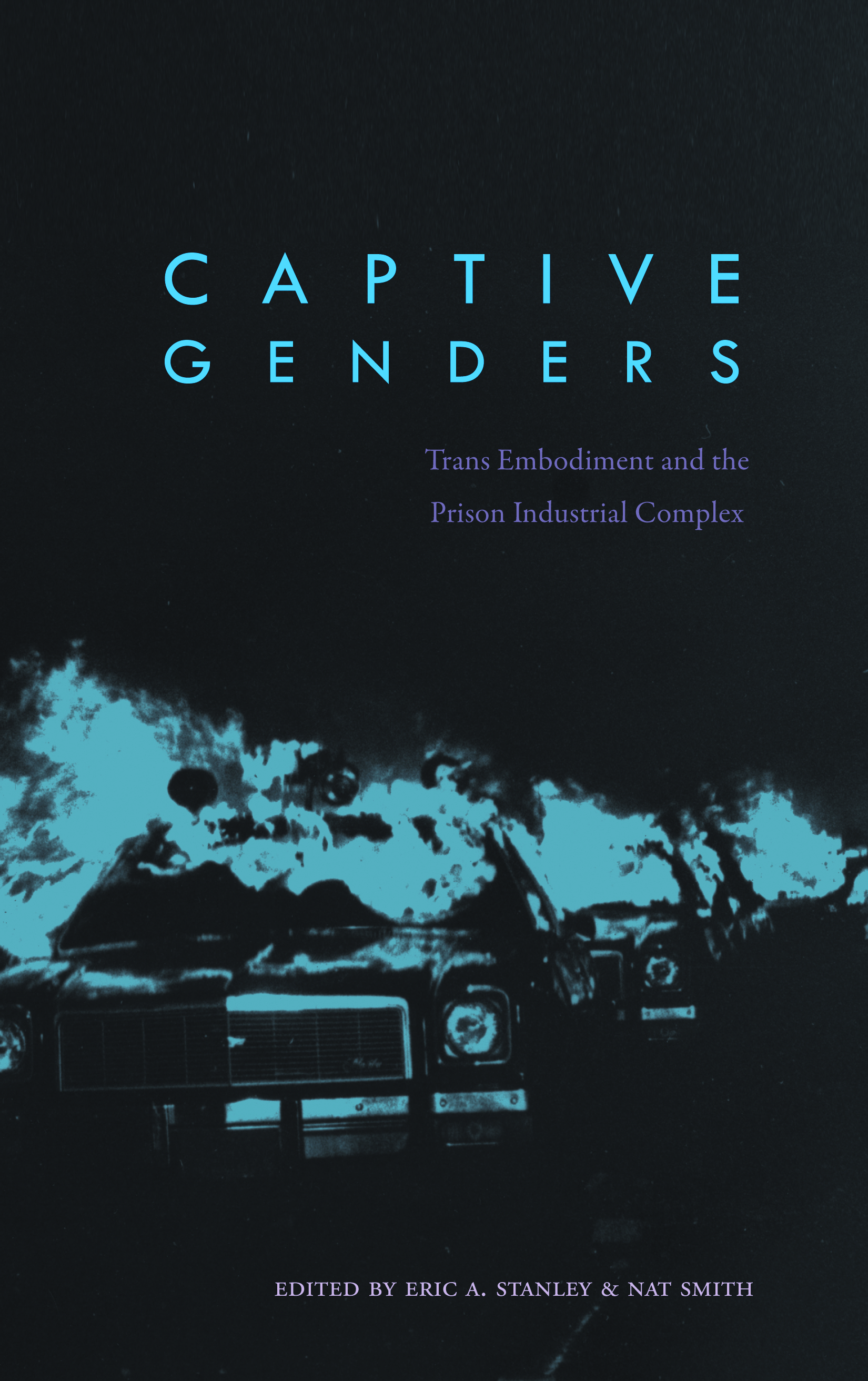 Captive Genders: Trans Embodiment and the Prison Industrial Complex, due in August from your own AK Press, is a collection of essays representing years of struggle in the transgender, gender variant, queer liberation movements, and the movement for the abolition of the prison industrial complex. It is the first of its kind—not simply a bridge, but a space for discourse about the linkages between these struggles. A vital new look at how gender and sexuality are lived under the crushing weight of corporal captivity!
We invited Eric Stanley, one of the editors of Captive Genders to interview some of the contributors to give you a better idea of what the book is about, in the words of the folks who have been inspired to take up their pens (or computers, typewriters, word processors). Take a look, and check out the book at akpress.org.
There will be more interviews taking place soon, so stay tuned!
In celebration of the August release of Captive Genders: Trans Embodiment and the Prison Industrial Complex, I asked two of the authors about their contributions to the collection and their current political work. Yasmin Nair is a Chicago-based writer, academic, and activist who has, for the last many years, worked in radical queer and immigration organizing. Ralowe T. Ampu currently lives in a residents hotel in San Francisco, works with Gay Shame and has worked with ACT UP and around the the New Jersey 4 case.
Eric Stanley: It’s now the 42nd anniversary of the Stonewall uprising and it seems for many trans and queer folks, specifically those marginalized by mainstream LGBT politics, little has changed in terms of police harassment, imprisonment and the ways the prison industrial complex destroys trans and queer possibilities. Obviously corporate gay pride celebrations are not the answer, so how do you two think we should situate Stonewall and its commemoration within the present?
Yasmin Nair: Well, for starters, I’d like us to think beyond and outside Stonewall. While clearly an important and historic event, pretending that this was the sole and singular event that somehow caused a radical uprising that then changed queer history for ever erases the fact that such moments of protest were going on before Stonewall, in the 1966 Compton’s riot in San Francisco, for example, or in Chicago, at the raid on The Trip, a gay bar, in 1968.
That being said, the commemoration of Stonewall or any queer uprising presents us with additional problems: on the one hand, mainstream gays and lesbians and straights continually erase the reality that such moments were largely initiated by trans people, hustlers, drag queens, very, very angry queens and queers – precisely the sort of misbehaving misfits they’d like to pretend don’t exist.
On the other hand, as the rest of us work to reinstate the central figures of Stonewall and other events and remind the world that Stonewall was not a Human Rights Campaign fundraiser, I’m also concerned about our unquestioned assumption that simply recovering these “forgotten heroes” is in itself a radical act. Yes, that resistance to authority was deeply important, but what were its long-term effects? And how did that resistance eventually become an anti-capitalist, anti-PIC movement as well? Well, we know that it did not, and what I see over and over again is a kind of recovery, which takes the form of “Stonewall was a riot,” or “Let’s not forget the drag queens,” but nothing beyond a fetishistic reclaiming of sexual identity as some kind of originary marker of radical politics. I’m impressed by any movement that challenges the status quo, but I also need to be clear on what that challenge represents and against whom.
Forty-two years later, we still see queers and straights being targeted for “sex crimes,” we still see the PIC growing in its capacity to profit from the incarceration of the economically and politically vulnerable, and there are now cases where people are being put in jail for debt, a resurrection of the long-ago debtors’ prisons. A lot of queers, especially the ones who don’t conform and can’t get jobs with health care and benefits, end up penniless; a lot of the drag queens and hustlers who participated in riots ended up bereft. I’m not interested in recovering any of them as lost heroes/heroines; I want to see more of a discussion about how they weren’t just screwed over by people who couldn’t stand their sexual identity, but by capitalism.
Frankly, I’m suffering from hero fatigue, and I’m tired of Pride parades which, even when they resist corporate takeovers, never go beyond some vaguely sexualized idea of a “radical” celebration that does nothing to really think through the neoliberal nightmare we live in.
I think Pride ought to become an occasion for queers to begin staging their own Prides, without corporate sponsorship, but with an awareness of the complications of economic and race issues.
Currently, in Chicago, for instance, we have an alternative Dyke March, but it became, over the course of a decade, a predominantly white and middle-class event. Even after it moved locations (first to the predominantly Latin@ west side, then to the largely African-American South Shore) there’s a great deal of talk about alternative politics, but not very much conscious conversation about what it means to, essentially, stage Dyke March in these communities and not very much explicit engagement with people, including queers, who live there. Instead, one day a year, we “take over the streets,” and then disappear. I’ve been to the alternative Dyke three out of the four years so far, and I can see its value as a kind of annual resting space/networking tool for queers with alternative politics, but I wish we would drop the pretense that moving the location is more than just marching in a different place.
I’d also like to see a month-long series of radical events and actions that question the queer fealty to the prison industrial complex and to capitalism while critiquing our collective obsession with identity as some marker of freedom. Over the years, I’ve seen queers increasingly support the systems that incarcerate the most vulnerable and marginalized amongst us, in the shape of hate crimes legislation or by turning a blind eye upon the blatant targeting of queers who engage in public sex, for instance. I’d like to see more of an explicit conversation about how the prison industrial complex not only targets queers but actually requires their support to help further its expansion. And, yes, I’d like us to think about that in terms of capitalism and its deployment of the rhetoric of rights, which we embrace too readily. You’ll note that I don’t simply bracket off gays and lesbians as the problem; I think that too many self-identified “radical” queers buy into the idea that somehow simply claiming queerness as an identity is in and of itself a radical act.
Ralowe Ampu: Within the last few years whenever I’ve overheard “respectable,” “clean,” “decent” folks in the Left talk about remembering riots like Compton’s Cafeteria or Stonewall it’s always been with suspicion. Last time I checked, riots don’t exist in the realm of respectability. My initial response is that the only ethical way to remember Stonewall is with another riot. There’s an interesting idea.
That idea relies on a political memory that uses convenient rhythms that can renew and imbue non-profit fiscal cycles with relevance. Such a notion would also play well with the sub-cultural frat-boy circuit that fetishizes and glamorizes such authentic moments of insurgency to further their own ableist agendas. I’m not sure why I’m attempting to conceal my resentment here. For the two milieus I’ve just described it’d be infinitely more useful for us all if they simply remained mum on our riots in their rhetoric, for the sake of maintaining consistency throughout their institutional practice.
Wouldn’t that make more sense? Until their institutions have been over-turned and revised? To attempt anything else would be to deny that these riots were moments of the powerless seriously asserting themselves in a hopeless situation. Yasmin rightly assesses the assimilationist machinations of the gay mainstream–these riots can’t be reduced to the theme of a fundraiser nor any other opportunistic distortions. Leading from there into campaigns about gay marriage and the military is in the very least ideologically incongruous and, if you would forgive me, outright profane. Nevertheless, these are the times that we find ourselves in.
Those of us that are disenfranchised by the gay mainstream don’t have the ability to represent Stonewall as a battle against police power because the gay mainstream reproduces their hegemonic narratives. You and I could throw together a flier and wheatpaste it or something, but shy of this riot of the disenfranchised (if that), it won’t receive international mass media coverage. This “anniversary” deserves nothing less. As time marches on, we should be thinking deeper and more thoroughly about the implications that this riot presented to the status quo. It’s precisely what this “anniversary” deserves. So I think that those of us that are marginalized can continue to think about interventions. What would it look like? It’s critical to recuperate our powerlessness and dream of intervention because it’s the best way to commemorate Stonewall without speciously memorializing it as a sign of progress.
Eric Stanley: You both, in different ways, call for an expanded understanding of the PIC to include spaces and ideologies not traditionally understood as such. For example: Yasmin, in your piece, “How to Make Prisons Disappear: Queer Immigrants, the Shackles of Love, and the Invisibility of the Prison Industrial Complex,” you call on us to understand the ways the “good immigrant vs. the bad immigrant” binary is maintained is in part a product of the PIC. In other words, while you do want us to pay attention to detention centers, you ask us to consider the entire discourse more broadly. Can you tell us more about that?
Yasmin Nair: Yes, those sorts of binaries are crucial to the discursive strengthening of the PIC. The best example of that has come about in my city, Chicago, where DREAM Act activists, predominantly undocumented youth who would benefit from the legislation, have used the rhetoric of “coming out” as an explicit form of “queering” the movement. A significant number of them, perhaps even the near majority, are in fact queer, and the discourse of “coming out” allows them to form a kind of solidarity with the gay movement. But it also allows them to emphasize that they are, like the mainstream gays whose support they seek, the “good” undocumented: the high school valedictorians, the ones who go on to universities like the University of Illinois or the University of Chicago and are working towards degrees in Law, the ones who will be “productive” citizens.
But there are many countless numbers of youth, queer or not, who have simply not been able to access the same advantages because they and their parents never “made it” – or who may not want to “make it,” for any number of reasons, including a deep suspicion of the state and its supposed munificence, or because they don’t care for the military component of the DREAM Act. Many of these youth recognize that they, like the majority of undocumented youth, are likely to have to take the military option and have no desire to support the US military regime in their countries of origin and/or around the globe. And these are the youth most susceptible to the PIC, because they offer nothing to the state in return, might be resistant its seductions via the PIC and the military, and lack the economic and cultural capital that is being accessed by the “good” ones. Immigrant’s rights groups are not going to fight the deportations of “slacker” undocumented youth or those who are openly critical of the military component.
In the meantime, in the public eye, such a combined discourse – of good gays and good undocumented youth – allows for a continued perception that only the good ones deserve “rights” – the right to health care through marriage, the right to demand that the PIC incarcerate more people, the right to immigration as long as normative requirements of citizenship are adhered to. In Chicago, what has been most disappointing to me is that an influential if putatively left/progressive bloc of the city has cleaved mightily to this same discourse of “good immigrant vs. bad immigrant,” without even, at the very least, acknowledging that it is problematic and deeply harmful to far more in the long run or that such a discourse legitimizes the extension of the PIC. This is why a critique of discourse is so necessary.
As someone who wants to see actual change come about, I’m not unaware of the compromises we are sometimes required to make, but it’s one thing to compromise and quite another to willfully erase the contradictions with which we find ourselves confronted. The DREAM Acters may well help get the legislation passed, and as someone with several friends who might benefit, I’d be happy to see that happen. But what do we then do about the youth left behind, the ones coerced into military service or the ones who, like, well, so many native-born teens, aren’t able to prove their exemplary status? At no time in history have those who won their “rights” ever then turned around and worked with or for the ones left behind – the reality of political success demands that you move on and forget the rest.
Eric Stanley: Ralowe, in your piece “Hotel Hell” you situate the SRO hotel you live in as a manifestation of the PIC, what do you think is unique about SROs that we should understand them in this way?
Ralowe Ampu: In my experience in San Francisco, SROs are specifically about containing and policing the bodies of poor people. The evidence of this is in how hotel operators respond to an assumption of a “criminal class.” It’s this property-owner culture that leads directly into fortifying points-of-sale in bulletproof glass. This culture of rationalizations can arise independently of an actual incident. The fact is that me and my neighbors have to constantly negotiate fortified enclosures and it settles into a routine. These architectural features are physical manifestations of the authoritarian power structure, and what I witness everyday are people indoctrinated into resigning from political agency.
These deep psychological costs are all always legitimized by hotel operator discourses on wanting to prevent “freeloaders” (multiple people in one room) and other activities associated with the underground economy. For example, in my hotel I can only have 10 overnight visitors a month, which works to control our sexual activity, at least in theory. All my visitors also have to show “proper” identification and are filmed on camera before they can be let through the metal cage. Most of my neighbors who live in my hotel are in-between some other form of institutionalization (mental institutions, prisons, immigration detention centers). All of us are subjected to the hotel operator’s material anxieties toward the “criminal class.”
I think it’s important to have this larger understanding of the PIC because spaces like my hotel are not often talked about, or organized in solidarity with, when people are doing anti-pic work. The PIC does not stop at the prison walls, so our organizing cannot either.
Eric Stanley: Finally, I know you have both been active in many collectives and groups. You, Yasmin, with Gender JUST in Chicago, and Ralowe with Gay Shame in San Francisco. How are you or your groups already working to support a trans/queer abolitionist politic?
Yasmin Nair: In Gender JUST (Justice United for Societal Transformation), our work is embedded in a deep awareness of how the PIC affects our lives. One of our campaigns is focused on Boystown (Lakeview, the historically gay epicenter of the city) and the Center on Halsted (the gay and lesbian center, although it coyly avoids calling itself such), and calls for an end to the hyped-up police surveillance of queer youth of color. In our work on schools and anti-bullying initiatives, we have been very clear, much to the chagrin of some local gay groups, that we don’t support anti-bullying legislation which simply makes it easier for schools to “fix” the problem by sending those identified as “bullies” into the correctional system or the PIC; we advocate instead for the principles of restorative justice in Chicago Public Schools. We have consistently spoken out against the militarization of CPS, which is the most militarized school district in the country. We were amongst the very few groups which did not support a proposal for a queer high school because we knew that it would do nothing to alleviate the very real issues of violence facing queer youth across CPS and would further bolster an increasingly privatized system. We simply don’t see queerness as existing separately from factors like poverty and economic inequality.
While ours is a significantly “queer” group, we resist the mainstream gay and lesbian agenda of insulating sexuality from capitalism and the violence of the prison industrial complex. And we have consistently been against hate crimes legislation.
Ralowe Ampu: Well, we have worked on the campaign to free the NJ4. We were a group of people organizing outside the non-profit industrial complex, mostly people from Gay Shame, LAGAI-Queer Insurrection, APOC (Anarchist People Of Color) and other non-affiliated folks. We worked to help free them and build a larger queer and trans abolitionist conversation. We put out zines; raised money for their commissary; wheat pasted; organized a demo in NYC; and had a workshop at [Critical Resistance's 10th anniversary conference] CR 10.
More specifically, Gay Shame has worked for many years to combat the rapid gentrification of the Polk, one of SF’s last remaining working class trans/queer neighborhoods. We have also given the Golden Gate Peace Officers Association (the gay cop group) a Gay Shame Award, highlighting the hypocrisy of them protecting and serving the same systems that require the destruction of our bodies to underwrite the status quo.
Captive Genders: Trans Embodiment and the Prison Industrial Complex, edited by Eric A. Stanley and Nat Smith, will be released on August 15, 2011 from AK Press. http://akpress.org/2011/items/captivegenders
Subscribe to:
Posts (Atom)