Showing posts with label gender. Show all posts

Contributors to Captive Genders take on policing, the LGBT mainstream and the re-writing of queer history.

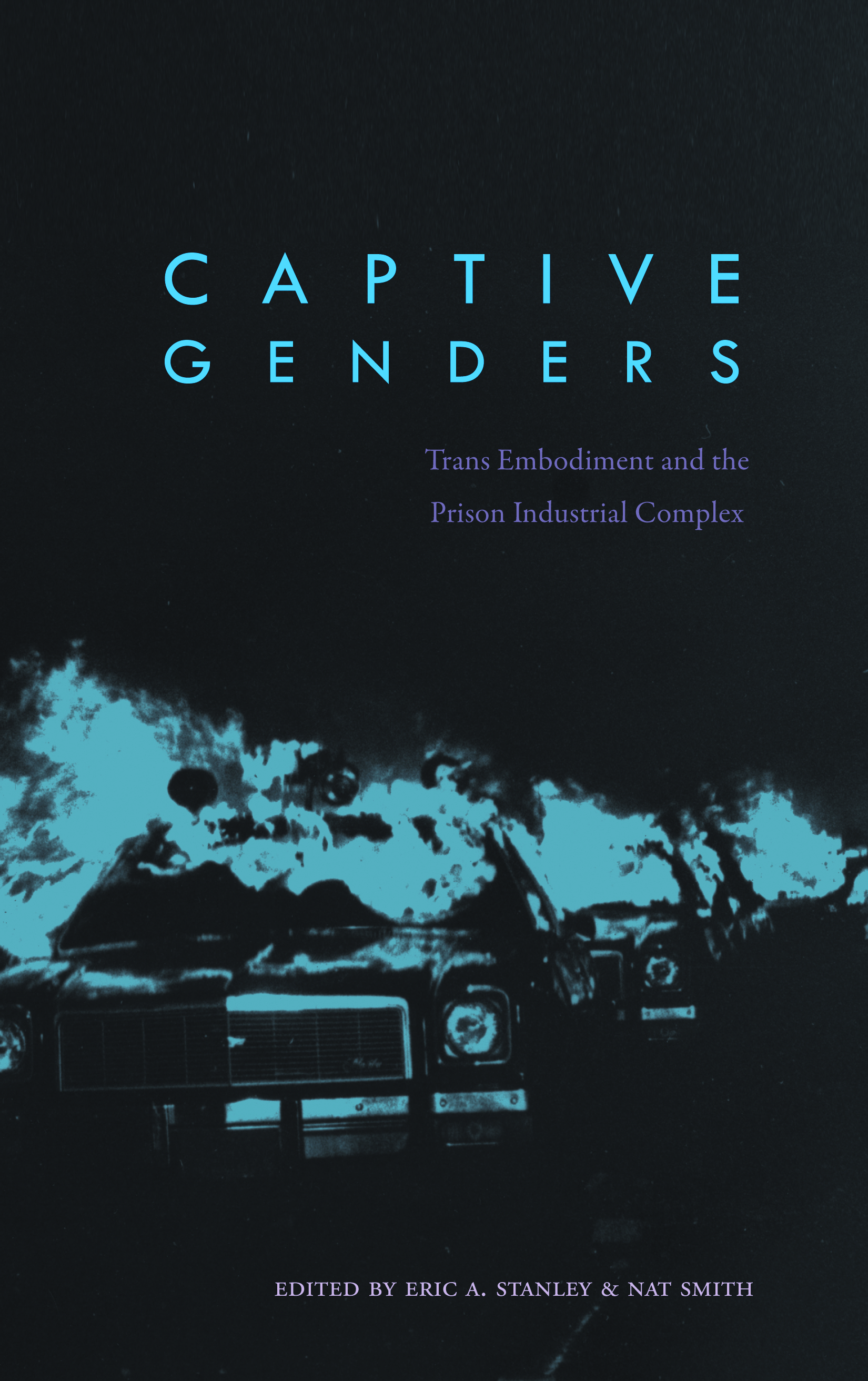
Captive Genders: Trans Embodiment and the Prison Industrial Complex,  due in August from your own AK Press, is a collection of essays representing years of struggle in the transgender, gender variant, queer liberation movements, and the movement for the abolition of the prison industrial complex. It is the first of its kind—not simply a bridge, but a space for discourse about the linkages between these struggles. A vital new look at how gender and sexuality are lived under the crushing weight of corporal captivity!

We invited Eric Stanley, one of the editors of Captive Genders to interview some of the contributors to give you a better idea of what the book is about, in the words of the folks who have been inspired to take up their pens (or computers, typewriters, word processors). Take a look, and check out the book at akpress.org.

There will be more interviews taking place soon, so stay tuned!


In celebration of the August release of Captive Genders: Trans Embodiment and the Prison Industrial Complex, I asked two of the authors about their contributions to the collection and their current political work. Yasmin Nair is a Chicago-based writer, academic, and activist who has, for the last many years, worked in radical queer and immigration organizing. Ralowe T. Ampu currently lives in a residents hotel in San Francisco,  works with Gay Shame and has worked with ACT UP and around the the New Jersey 4 case.
Eric Stanley: It’s now the 42nd anniversary of the Stonewall uprising and it seems for many trans and queer folks, specifically those marginalized by mainstream LGBT politics, little has changed in terms of police harassment, imprisonment and the ways the prison industrial complex destroys trans and queer possibilities. Obviously corporate gay pride celebrations are not the answer, so how do you two think we should situate Stonewall and its commemoration within the present? 

Yasmin Nair: Well, for starters, I’d like us to think beyond and outside Stonewall. While clearly an important and historic event, pretending that this was the sole and singular event that somehow caused a radical uprising that then changed queer history for ever erases the fact that such moments of protest were going on before Stonewall, in the 1966 Compton’s riot in San Francisco, for example, or in Chicago, at the raid on The Trip, a gay bar, in 1968.

That being said, the commemoration of Stonewall or any queer uprising presents us with additional problems: on the one hand, mainstream gays and lesbians and straights continually erase the reality that such moments were largely initiated by trans people, hustlers, drag queens, very, very angry queens and queers – precisely the sort of misbehaving misfits they’d like to pretend don’t exist.

On the other hand, as the rest of us work to reinstate the central figures of Stonewall and other events and remind the world that Stonewall was not a Human Rights Campaign fundraiser, I’m also concerned about our unquestioned assumption that simply recovering these “forgotten heroes” is in itself a radical act. Yes, that resistance to authority was deeply important, but what were its long-term effects? And how did that resistance eventually become an anti-capitalist, anti-PIC movement as well? Well, we know that it did not, and what I see over and over again is a kind of  recovery, which takes the form of “Stonewall was a riot,” or “Let’s not forget the drag queens,” but nothing beyond a fetishistic reclaiming of sexual identity as some kind of originary marker of radical politics. I’m impressed by any movement that challenges the status quo, but I also need to be clear on what that challenge represents and against whom.

Forty-two years later, we still see queers and straights being targeted for “sex crimes,” we still see the PIC growing in its capacity to profit from the incarceration of the economically and politically vulnerable, and there are now cases where people are being put in jail for debt, a resurrection of the long-ago debtors’ prisons. A lot of queers, especially the ones who don’t conform and can’t get jobs with health care and benefits, end up penniless; a lot of the drag queens and hustlers who participated in riots ended up bereft. I’m not interested in recovering any of them as lost heroes/heroines; I want to see more of a discussion about how they weren’t just screwed over by people who couldn’t stand their sexual identity, but by capitalism.

Frankly, I’m suffering from hero fatigue, and I’m tired of Pride parades which, even when they resist corporate takeovers, never go beyond some vaguely sexualized idea of a “radical” celebration that does nothing to really think through the neoliberal nightmare we live in.

I think Pride ought to become an occasion for queers to begin staging their own Prides, without corporate sponsorship, but with an awareness of the complications of economic and race issues.

Currently, in Chicago, for instance, we have an alternative Dyke March, but it became, over the course of a decade, a predominantly white and middle-class event. Even after it moved locations (first to the predominantly Latin@ west side, then to the largely African-American South Shore) there’s a great deal of talk about alternative politics, but not very much conscious conversation about what it means to, essentially, stage Dyke March in these communities and not very much explicit engagement with people, including queers, who live there. Instead, one day a year, we “take over the streets,” and then disappear. I’ve been to the alternative Dyke three out of the four years so far, and I can see its value as a kind of annual resting space/networking tool for queers with alternative politics, but I wish we would drop the pretense that moving the location is more than just marching in a different place.
I’d also like to see a month-long series of radical events and actions that question the queer fealty to the prison industrial complex and to capitalism while critiquing our collective obsession with identity as some marker of freedom. Over the years, I’ve seen queers increasingly support the systems that incarcerate the most vulnerable and marginalized amongst us, in the shape of hate crimes legislation or by turning a blind eye upon the blatant targeting of queers who engage in public sex, for instance. I’d like to see more of an explicit conversation about how the prison industrial complex not only targets queers but actually requires their support to help further its expansion. And, yes, I’d like us to think about that in terms of capitalism and its deployment of the rhetoric of rights, which we embrace too readily. You’ll note that I don’t simply bracket off gays and lesbians as the problem; I think that too many self-identified “radical” queers buy into the idea that somehow simply claiming queerness as an identity is in and of itself a radical act.

Ralowe Ampu: Within the last few years whenever I’ve overheard “respectable,” “clean,” “decent” folks in the Left talk about remembering riots like Compton’s Cafeteria or Stonewall it’s always been with suspicion. Last time I checked, riots don’t exist in the realm of respectability. My initial response is that the only ethical way to remember Stonewall is with another riot. There’s an interesting idea.

That idea relies on a political memory that uses convenient rhythms that can renew and imbue non-profit fiscal cycles with relevance. Such a notion would also play well with the sub-cultural frat-boy circuit that fetishizes and glamorizes such authentic moments of insurgency to further their own ableist agendas. I’m not sure why I’m attempting to conceal my resentment here. For the two milieus I’ve just described it’d be infinitely more useful for us all if they simply remained mum on our riots in their rhetoric, for the sake of maintaining consistency throughout their institutional practice.

Wouldn’t that make more sense? Until their institutions have been over-turned and revised? To attempt anything else would be to deny that these riots were moments of the powerless seriously asserting themselves in a hopeless situation. Yasmin rightly assesses the assimilationist machinations of the gay mainstream–these riots can’t be reduced to the theme of a fundraiser nor any other opportunistic distortions. Leading from there into campaigns about gay marriage and the military is in the very least ideologically incongruous and, if you would forgive me, outright profane. Nevertheless, these are the times that we find ourselves in.

Those of us that are disenfranchised by the gay mainstream don’t have the ability to represent Stonewall as a battle against police power because the gay mainstream reproduces their hegemonic narratives. You and I could throw together a flier and wheatpaste it or something, but shy of this riot of the disenfranchised (if that), it won’t receive international mass media coverage. This “anniversary” deserves nothing less. As time marches on, we should be thinking deeper and more thoroughly about the implications that this riot presented to the status quo. It’s precisely what this “anniversary” deserves. So I think that those of us that are marginalized can continue to think about interventions. What would it look like? It’s critical to recuperate our powerlessness and dream of intervention because it’s the best way to commemorate Stonewall without speciously memorializing it as a sign of progress.

Eric Stanley: You both, in different ways, call for an expanded understanding of the PIC to include spaces and ideologies not traditionally understood as such. For example: Yasmin, in your piece, “How to Make Prisons Disappear: Queer Immigrants, the Shackles of Love, and the Invisibility of the Prison Industrial Complex,” you call on us to understand the ways the “good immigrant vs. the bad immigrant” binary is maintained is in part a product of the PIC. In other words, while you do want us to pay attention to detention centers, you ask us to consider the entire discourse more broadly. Can you tell us more about that? 

Yasmin Nair: Yes, those sorts of binaries are crucial to the discursive strengthening of the PIC. The best example of that has come about in my city, Chicago, where DREAM Act activists, predominantly undocumented youth who would benefit from the legislation, have used the rhetoric of “coming out” as an explicit form of “queering” the movement. A significant number of them, perhaps even the near majority, are in fact queer, and the discourse of “coming out” allows them to form a kind of solidarity with the gay movement. But it also allows them to emphasize that they are, like the mainstream gays whose support they seek, the “good” undocumented: the high school valedictorians, the ones who go on to universities like the University of Illinois or the University of Chicago and are working towards degrees in Law, the ones who will be “productive” citizens.

But there are many countless numbers of youth, queer or not, who have simply not been able to access the same advantages because they and their parents never “made it” – or who may not want to “make it,” for any number of reasons, including a deep suspicion of the state and its supposed munificence, or because they don’t care for the military component of the DREAM Act. Many of these youth recognize that they, like the majority of undocumented youth, are likely to have to take the military option and have no desire to support the US military regime in their countries of origin and/or around the globe. And these are the youth most susceptible to the PIC, because they offer nothing to the state in return, might be resistant its seductions via the PIC and the military, and lack the economic and cultural capital that is being accessed by the “good” ones. Immigrant’s rights groups are not going to fight the deportations of “slacker” undocumented youth or those who are openly critical of the military component.

In the meantime, in the public eye, such a combined discourse – of good gays and good undocumented youth – allows for a continued perception that only the good ones deserve “rights” – the right to health care through marriage, the right to demand that the PIC incarcerate more people, the right to immigration as long as normative requirements of citizenship are adhered to. In Chicago, what has been most disappointing to me is that an influential if putatively left/progressive bloc of the city has cleaved mightily to this same discourse of “good immigrant vs. bad immigrant,” without even, at the very least, acknowledging that it is problematic and deeply harmful to far more in the long run or that such a discourse legitimizes the extension of the PIC. This is why a critique of discourse is so necessary.

As someone who wants to see actual change come about, I’m not unaware of the compromises we are sometimes required to make, but it’s one thing to compromise and quite another to willfully erase the contradictions with which we find ourselves confronted. The DREAM Acters may well help get the legislation passed, and as someone with several friends who might benefit, I’d be happy to see that happen. But what do we then do about the youth left behind, the ones coerced into military service or the ones who, like, well, so many native-born teens, aren’t able to prove their exemplary status? At no time in history have those who won their “rights” ever then turned around and worked with or for the ones left behind – the reality of political success demands that you move on and forget the rest.


Eric Stanley: Ralowe, in your piece “Hotel Hell” you situate the SRO hotel you live in as a manifestation of the PIC, what do you think is unique about SROs that we should understand them in this way?

Ralowe Ampu: In my experience in San Francisco, SROs are specifically about containing and policing the bodies of poor people. The evidence of this is in how hotel operators respond to an assumption of a “criminal class.” It’s this property-owner culture that leads directly into fortifying points-of-sale in bulletproof glass. This culture of rationalizations can arise independently of an actual incident. The fact is that me and my neighbors have to constantly negotiate fortified enclosures and it settles into a routine. These architectural features are physical manifestations of the authoritarian power structure, and what I witness everyday are people indoctrinated into resigning from political agency.

These deep psychological costs are all always legitimized by hotel operator discourses on wanting to prevent “freeloaders” (multiple people in one room) and other activities associated with the underground economy. For example, in my hotel I can only have 10 overnight visitors a month, which works to control our sexual activity, at least in theory. All my visitors also have to show “proper” identification and are filmed on camera before they can be let through the metal cage. Most of my neighbors who live in my hotel are in-between some other form of institutionalization (mental institutions, prisons, immigration detention centers). All of us are subjected to the hotel operator’s material anxieties toward the “criminal class.”

I think it’s important to have this larger understanding of the PIC because spaces like my hotel are not often talked about, or organized in solidarity with, when people are doing anti-pic work. The PIC does not stop at the prison walls, so our organizing cannot either.

Eric Stanley: Finally, I know you have both been active in many collectives and groups. You, Yasmin, with Gender JUST in Chicago, and Ralowe with Gay Shame in San Francisco. How are you or your groups already working to support a trans/queer abolitionist politic? 

Yasmin Nair: In Gender JUST (Justice United for Societal Transformation), our work is embedded in a deep awareness of how the PIC affects our lives. One of our campaigns is focused on Boystown (Lakeview, the historically gay epicenter of the city) and the Center on Halsted (the gay and lesbian center, although it coyly avoids calling itself such), and calls for an end to the hyped-up police surveillance of queer youth of color. In our work on schools and anti-bullying initiatives, we have been very clear, much to the chagrin of some local gay groups, that we don’t support anti-bullying legislation which simply makes it easier for schools to “fix” the problem by sending those identified as “bullies” into the correctional system or the PIC; we advocate instead for the principles of restorative justice in Chicago Public Schools. We have consistently spoken out against the militarization of CPS, which is the most militarized school district in the country. We were amongst the very few groups which did not support a proposal for a queer high school because we knew that it would do nothing to alleviate the very real issues of violence facing queer youth across CPS and would further bolster an increasingly privatized system. We simply don’t see queerness as existing separately from factors like poverty and economic inequality.

While ours is a significantly “queer” group, we resist the mainstream gay and lesbian agenda of  insulating sexuality from capitalism and the violence of the prison industrial complex. And we have consistently been against hate crimes legislation.

Ralowe Ampu: Well, we have worked on the campaign to free the NJ4. We were a group of people organizing outside the non-profit industrial complex, mostly people from Gay Shame, LAGAI-Queer Insurrection, APOC (Anarchist People Of Color) and other non-affiliated folks. We worked to help free them and build a larger queer and trans abolitionist conversation. We put out zines; raised money for their commissary; wheat pasted; organized a demo in NYC; and had a workshop at [Critical Resistance's 10th anniversary conference] CR 10.

More specifically, Gay Shame has worked for many years to combat the rapid gentrification of the Polk, one of SF’s last remaining working class trans/queer neighborhoods. We have also given the Golden Gate Peace Officers Association (the gay cop group) a Gay Shame Award, highlighting the hypocrisy of them protecting and serving the same systems that require the destruction of our bodies to underwrite the status quo.

Captive Genders: Trans Embodiment and the Prison Industrial Complex, edited by Eric A. Stanley and Nat Smith, will be released on August 15, 2011 from AK Press. http://akpress.org/2011/items/captivegenders

Judith Butler - Gender is Extramoral

Judith Butler and Fina Birulés (Interviewer). “Gender is Extramoral.” Interview with Judith Butler. Barcelona Metropolis. Summer, June – September 2008.


Essayist, thinker and professor in the Department of Rhetoric at the University of California, Berkeley, Butler is best known for her studies of gender and sexuality, in which she examines the question of what it means to remake, to resignify, the restrictive normative concepts of sexual life and gender.

Is it possible to establish any relation between the political transformations deriving from the events of 11 September 2001 - the decline in nation-state sovereignty and the centrality of security policies - and transformations in political subjectivity and gender? In her latest writings the philosopher Judith Butler has outlined an "ontology of vulnerability" that is moving in this direction.

Her work, Gender Trouble. Feminism and the Subversion of Identity (1990), apart from being one of the most widely read texts in feminism, is also considered to be one of the founding texts of Queer Theory, a current within gay and lesbian studies that sets out to flee from theoretical impositions and from culturally and socially determined notions about the difference between the sexes.

Unwilling to speak in terms of 'post-feminism', Butler takes as her starting points the conceptual and political resources that form part of the feminist tradition so as to rethink the category of gender in terms that go beyond the difference between masculine and feminine, instead reformulating the question around the idea of "that which is human". The US philosopher emphasises the need to resist the temptation to resolve the discrepancies into a unity, since, in her opinion, it is precisely dissension that keeps thought and political struggle alive.

This interview took place in February 2008 on the occasion of a talk by Judith Butler at the Centre de Cultura Contemporània de Barcelona (CCCB).

Fina Birulés: Could you explain your conception of critical thought and its relation with Foucault's famous words: "I do not know if today it is necessary to say that critical work still implies faith in the Enlightenment; I consider that it must always work on our limits, that is, a patient labour that forms the impatience for freedom"? In one of your latest texts you refer to this; perhaps you could relate the task of critical thought and its connection with feminism.

Judith Butler: The critical task demands a preoccupation with limits, and Foucault was particularly interested in the problem of how this delimited field shapes the subject. Thus, if we are formed as obedient subjects, if the state or some other regulated form of power imposes itself on us and we accept it, we become obedient subjects. But in the moment we begin to ask ourselves about the legitimacy of this power we become critical, we adopt a point of view that is not completely shaped by the state and we question ourselves about the limits of the demands that can be placed on us. Foucault is very clear in this respect: questioning the demand for obedience made of us by the state means questioning our ontology as subjects.

And if I am not wholly formed by this power of the state, in what way am I, or might I be, formed? Asking yourself this question means you are already beginning to form yourself in another way, outside this relation with the state, so critical thought distances you to some extent. When someone says "no" to power, they are saying "no" to a particular way of being formed by power. They are saying: I am not going to be subjected in this way or by these means through which the state establishes its legitimacy. The critical position implies a certain "no", a saying "no" as an "I", and this, then, is a step in the formation of this "I". Many people ask about the basis on which Foucault establishes this resistance to power. What he is saying to us is that in the practice of critical thought we are forming ourselves as subjects, through resistance and questioning. Foucault does not presuppose a pre-existing subject that can say "no" and criticise authority. Rather that the subject forms him or herself through the practice of criticism. And, in my view, some forms of criticism involve a questioning of the intelligibility of the norms that constitute us as people. If the powers that be address me as a citizen or as a non-citizen, in terms of a gender or a racial category, I must fight against this social determination. The norms establish my social intelligibility, the categories through which I understand myself and other people. If, from the very outset, a gender is attributed to me, if I am called a "girl", then I actively am a girl; the "I" that emerges through this gender is intelligible, in part, as a social being: the gender attribute to me guarantees my intelligibility and my legibility as a person, and if I question this gender, I risk a certain unintelligibility, risk losing my place and my social legibility as a particular person. However, the "I" could say "no" or could ask "why?" With what means, for what end have I been generated, with what right has this medical establishment attributed a particular gender to me, or with what right has the law attributed this gender to me? The "I" steps back from these gender norms, even if such norms are the conditions that have determined its formation; that is, it does not abandon or destroy them, but it does wrestle with them. Is it possible to reconstruct gender? And if so, can this be understood as a practice of freedom? Can it be understood as a way of becoming? And if so, what other formations are possible? In my opinion, feminism implies thinking about the practices of freedom: when we object to discriminatory practices at work, to forced reclusion within the private domain, when we protest about violence against women..., it is not only because we want women to achieve equality, to be treated justly. Equality and justice are very important norms, but there are more: we want certain freedoms for women so they are not totally limited to the established ideas of femininity or even of masculinity. We want them to be capable of innovating and creating new positions. Insofar as feminism has been, at least in part, a kind of philosophy, it is crucial that it develops new notions of gender. If feminism suggests that we cannot question our sexual positions or affirm that we have no need of the category of gender, then it would be saying, in some sense, that I should accept a particular positionality or a particular structure - restrictive for me and for others - and that I am not free to make and remake the form, or the terms in which I have been made. And it is true that I cannot change these terms radically, and even if I decide to resist the category of woman, I will have to battle with this category throughout my whole life. In this way, whenever we question our gender we run the risk of losing our intelligibility, of being labelled 'monsters'. My struggle with gender would be precisely that, a struggle, and that has something to do with the patient labour that forms the impatience for freedom. Thus, gender perfomativity can be understood: the slow and difficult practice of producing new possibilities of experiencing gender in the light of history, and in the context of very powerful norms that restrict our intelligibility as human beings. They are complex struggles, political in nature, since they insist on new forms of recognition. In fact, from my experience of feminism, these political struggles have been being waged for the last hundred years, at the very least. I only offer a radical language for these struggles.

Fina Birulés: Speaking about performativity and the possibility of new forms of being, the question arises of how to evaluate the diverse innovative forms of agency, because not everything that is novel is necessarily 'good'. In your Undoing Gender you speak a little about this, but is there any single criterion that will allow us to make this distinction? Is it pertinent here to speak of universality?

Judith Butler: If we are referring to the various ways in which gender is understood as a form or a cultural interpretation of the body, I believe it is not appropriate to speak of good or bad genders:

gender is extra-moral. Those who wish to establish the distinction between normal genders and pathological genders, or who set out to regulate gender are making a mistake. They are absolutely and universally wrong. There are illegitimate operations of power that attempt to restrict our idea of what gender might be, for example in the areas of medicine, law, psychiatry, social policy, immigration policy, or the policies against violence. My commitment involves opposition to all restrictive and violent measures that are used to regulate and restrict the life of gender. There are certain types of freedoms and practices that are very important for human flourishing. Any excessive restriction of gender limits, or undermines, the capacity of humans to flourish. And, what is more, I would add that this human flourishing is a good thing. I am aware that there I am taking a moral standpoint here; I know that I have a strong normative structure, but this has nothing to do with saying "this kind of gender is good and this one is bad". To do so would constitute a dangerous use of morality; rather, I am trying to shift the moral structure towards another framework in which we can ask ourselves: how does a body survive?, what is a flourishing body?, what does it need to flourish in the world? And it needs various things: it needs to be nourished, to be touched, to be in social settings of interdependence, to have certain expressive and creative capacities, to be protected from violence, and to have its life sustained in a material sense.

Today there are many people with modalities of gender that are considered unacceptable - the sexual or gender minorities - and who are discriminated against, considered abnormal, by the discourses of psychiatry or psychology, or who are the object of physical violence. These people are not being given the opportunity of having their lives recognised as worthy of being protected or helped, not even as lives that deserve to be mourned. I question the norms of gender that prevent us or make us incapable of recognising certain lives as being worth living, and which stop us providing the material conditions necessary for these lives to be lived, to flourish. For these lives to be publicly recognised also means their being understood as lives whose disappearance would be felt as a loss.

The same thing happens in war: certain lives are deemed worthy of being protected, while others are considered expendable, of negligible importance, radically dispensable. One could say that all my work revolves around this question: what is it that counts as a life? And in what way do certain restrictive norms of gender decide for us? What kind of life is worth protecting and what kind of life is not?

Fina Birulés: In recent years important changes have taken place in many aspects of the lives of gays, lesbians and even transsexuals. For example, in our country same-sex marriages have been made legal. In the light of your reflections about the way in which a broader context of intelligibility has ontological consequences, it might be useful to ask to what extent this recognition could end up leading to new forms of restriction, other forms of normality.

Judith Butler: Of course, if marriage exists, then homosexual marriage should also exist; marriage should be extended to all couples irrespective of their sexual orientation; if sexual orientation is an impediment, then marriage is discriminatory. For my part, I don't understand why it should be limited to two people, this appears arbitrary to me and might potentially be discriminatory; but I know this point of view is not very popular. However, there are forms of sexual organisation that do not imply monogamy, and types of relationship that do not imply marriage or the desire for legal recognition - even if they do seek cultural acceptance. There are also communities made up of lovers, ex-lovers and friends who look after the children, communities that constitute complex kinship networks that do not fit the conjugal pattern.

I agree that the right to homosexual marriage runs the risk of producing a conservative effect, of making marriage an act of normalisation, and thereby presenting other very important forms of intimacy and kinship as abnormal or even pathological. But the question is: politically, what do we do with this? I would say that every campaign in favour of homosexual marriage ought also to be in favour of alternative families, the alternative systems of kinship and personal association. We need a movement that does not win rights for some people at the expense of others. And imagining this movement is not easy.

The demand for recognition by the state should go hand in hand with a critical questioning: what do we need the state for? Although there are times that we need it for some kinds of protection (immigration, property, or children), should we allow it to define our relationships? There are forms of relation that we value and that cannot be recognised by the state, where the recognition of civil society or the community is enough. We need a movement that remains critical, that formulates these questions and keeps them open.

Fina Birulés: I would like to bring up a thinker I have been working on in the last few years, Hannah Arendt. I believe there are aspects of her thought that interest you. Where would you situate Arendt's distinction between liberation and liberty in your work? Similarly, how does the concept of responsibility fit into your reflections about the importance of performativity and resignification as political practices?

Judith Butler: It is true that, in general, I do not think of freedom in terms of liberation. I continue to be very strongly influenced by Foucault's History of Sexuality, in which he warns us against imagining a complete liberation from power. There can never be a total liberation from power, especially in relation to the politics of sexuality. Foucault says two things at the same time: we can never totally liberate ourselves from power (there is no space from which to say "no" to power) and, on the other hand, we are never completely determined by power. Thus, despite the impossibility of transcending power, a space of liberty opens up, and both determinism and radical voluntarism are refuted. What is this space of freedom that opens up once we have understood this? Here freedom is a kind of practice, a struggle, a continuous process with neither a beginning nor an end. When this practice is systematically attacked we cannot function as political subjects, our political capacities have been undermined.

When referring to freedom, I am not alluding to the idea of an individual subject, alone, since a subject is free to the extent that s/he is conditioned by conventions, norms and cultural possibilities that make freedom possible, though they do not determine it. They are the conditions of possibility of freedom. Who we are as subjects of freedom depends on non-voluntary forms of connection with others; I was not only born within a series of rules or conventions that form me, but also within a series of relationships on which I depend for my survival and which constitute me as an interdependent creature in this world. The questions of responsibility emerge in the context of this sociality, this interdependence.

On the matter of responsibility I am interested in the productive formulations made by Levinas. For Levinas, I am not responsible for my actions - though in fact I also am - but rather responsible for the Other, for the demands of the Other. And any demand made by the Other is prior to any possibility of social contract: whatever the demand the Other puts before me, it affects me, it involves me in a relation of responsibility.

Legal contracts cannot adequately describe this situation of primary responsibility. That means that I am responsible even for those who are not in any form of contractual relationship with me, or who do not form part of my community, or my nation, or who are not covered by the same legal framework as me. This helps to understand, for example, how I can be responsible for those who live at a distance from me, who are under a different form of political organisation, or those who are stateless. In Levinas' framework, even those we never meet, those whose names and faces we do not know, present us with a demand. It is, then, a question of accepting our global interdependence and even our obligation to protect the lives of those we do not know. For Levinas, this primary obligation is expressed through what we commonly call commandments, "Thou shall not kill": a requirement to preserve life. This does not mean that I can or should preserve the life of every individual (of course I cannot do so, and to imagine I could would be unhealthy, it would imply some sort of narcissism, a certain messianism), but rather that I should think about what kind of political structures we need to sustain life and minimise those forms of violence that extinguish it. This does not mean I am capable of making these structures come into existence - responsibility is not the same as efficacy - but rather that I can fight for a world that maximises the possibility of preserving and sustaining life and minimises the possibility of those forms of violence that, illegitimately, take life, or at least reduce the conditions that make it possible for this to happen. This is part of what I am thinking about at the moment. And I have to say that it is not easy to situate Arendt in this context.

Despite the fact that Levinas himself was not a pacifist, I believe that, taking his ideas as a starting point, it is possible to develop a philosophy of non-violence and even a conception of a trans-national political community that holds these values to be fundamental. We have to take Levinas' framework and develop a kind of trans-national ethics based on non-violence, and thus it is necessary to disagree with him with respect to the difference between ethics and politics, to his stand on pacifism, and on Israel.

Fina Birulés: Certainly, we are not only responsible for what we have done; responsibility points towards the interplay of autonomy and limit. To the extent that we always live and survive through some sort of consent that can hardly be considered voluntary, political responsibility also has to do with the idea that we are aware of, that we hope will continue, that we want to innovate or conserve. In this sense, unless our attitude towards the world is one of indifference, we can talk about a kind of political responsibility in the maintenance of structures and habits or values that, in many spheres, impede the possibility of feminine freedom.

Judith Butler: Let me start with a criticism Derrida made of Levinas: if it is necessary to respond to all demands, that means an infinite number of demands, and how should we decide which group of demands to respond to? Perhaps responsibility is only made possible by circumscribing a group of demands, that is, by becoming irresponsible in relation to all other demands. In a way that is characteristic of him, Derrida affirms that responsibility, in Levinas' sense, leads to a necessary irresponsibility. Yet this is to continue to misunderstand the singularity of the demands made on us. It's not enough to deal with them case by case. Let's think, for example, about violence against women: it is true that we can consider a rapist or an aggressor to be responsible before the law; in a legal framework, he will have to pay for his acts, will have to be punished, once evidence of his guilt has been provided. No doubt we need a punitive legal institution, but the question is whether, once legal responsibility has been assumed, this means that full responsibility has now been apportioned. Legal responsibility is not an adequate model for conceptualising the whole range of responsibilities we have, because there remains a fundamental question to resolve: rape and domestic violence continue. Why do these social practices reproduce themselves time and again in a culture? A broader kind of intervention seems to me to be necessary, a kind of outcry about violence against women, and against sexual minorities; I believe it is very important to relate them: violence against transsexuals, for example, against sex workers, against illegal immigrants who can have no recourse to law, and violence against many groups who have been dispossessed of all their rights. I consider that we need a strong policy that connects all these forms of violence, and also demands the production, through the mass media, of an education, an ethos, that would act as a counterweight to these forms of violence.
If you examining all this, case by case, you lose sight of the horizon: these forms of violence form part of a social practice - are even socially acceptable amongst certain types of men - of a social model.

But how can we intervene at the level of social practices? By using the law, certainly, but not only in this way, given that we have a responsibility to remake the world, and to institute certain standards of non-violence on a more general level. Political responsibility must go hand in hand with legal responsibility.

Fina Birulés: In your latest books you deal with the issue of the place occupied by passions and emotions, like pain and vulnerability in politics. Similarly, you point to the urgency of asking ourselves "what is means to be human?" Isn't it a little surprising that all this should be written by an author who appears to form part of the anti-humanist tradition, part of the tradition that is known in the USA as French Theory?

Judith Butler: It is necessary to be careful when we talk about 'humanism'. We only have to look at the various legacies of humanism to see that there is not just one kind of humanism: the forms that emerge in Italy are very distinct from those that emerge in France. There is also a humanism based in classical liberal political philosophy that can not be assimilated into literary humanism. In any case, if we agree that philosophical anthropology is a form of humanism that supposes that there is just one single idea of what it is to be human, and that it is possible to attribute defining traits to this human subject, then we are taking that which is human as something given, something that already exists.
What I want to suggest is the following: for humanness to become possible - in specific times and places - depends on certain types of social norms that are involved in the exercise of producing and 'de-producing' humanness. In other words, for that which is human to be human, it must be in relationship with that which is inhuman or non-human, and this is a differential operation of power. Humanness is produced and sustained in one form and is 'de-produced' and not sustained in other forms: the human being is a differentiating effect of power.

In the USA, for example, at present there is a very powerful discourse that sets out to define humanness as being a product of the Judeo-Christian tradition. Similarly, we have some morphological policies that define humanness in terms of certain ideas about what a human body should be like. And this produces a population with disabilities, or of disabled individuals whose bodies do not match the morphological idea. Remember that any regulatory ideal of humanness always produces exclusions, 'outsiders', and creates a problem: how should we refer to these beings that appear human but are not? We only have to think of the history of slavery, something which survives in the USA, where it remains unclear if all the black men who are imprisoned are human or not.

Humanness is not something given, it is a differentiating effect of power, but we need the term because without it we cannot understand what is happening. I am worried by those positions that say: "that which is human belongs to humanism, so we can never talk any more about humanness"; "choice belongs to voluntarism, we have to stop talking about choice"; "the Enlightenment belongs to that which we have dismantled, so we can no longer speak of Enlightenment". But they don't ask themselves what the Enlightenment was. Why go back to that which was? Why go back to humanness? Well, because these concepts, these really important ideals, have not left us, they continue to form us. And there is a new way of understanding them that starts with the idea that they do not have a single form and that, in fact, their regulation operates politically to produce exclusions that we must challenge. For someone to say that a person who is considered non-human is, in fact, human means a resignification of humanness and emphasises that humanness can work in another form. On occasions it is important to use the term precisely in the way that the Human Rights discourse sometimes does: taking someone to whom the defining characteristics of humanness are not attributed and affirming that person is human is a performative act that redefines humanness in terms of liberation, as emancipation. It is not a question of searching for what was already there, but of making it happen.

Fina Birulés: In your recent reflections, when you talk about 'that which is human' you connect it with the question of which lives deserve to be recognised as being worthy of being protected or helped. When you speak about 'life', are you taking as your starting point the distinction between bios and zoe?

Judith Butler: The question of life is difficult; I have my doubts about the way in which the distinction that Arendt establishes in the Human Condition has been popularised by Giorgio Agamben. Despite the fact that bios and zoe are analytically distinguishable, each is always implied in the other. I have problems when Arendt affirms that the point of life cannot be life itself. For her it is a terrible idea, since she only understands life as something that is bound up with very important principles and values. Arendt wanted to distinguish between life that was not worth living and life itself, and in this she was following Socrates: an unexamined life was not worth living. That is why, for her, thinking, judging and responsibility were so important, because she understood that these human activities make life worth living, and if these are not possible, then neither is life. But this does not help us to understand why it is necessary to preserve the life of sensate beings, including human beings.

Arendt distinguishes between the public and private spheres. The public domain is where we think, judge act; the private domain means that someone looks after the home, the food, the reproduction of the material conditions of life. It seems to me to be worth remembering that there is a politics of this sphere, a politics of the domestic, there is a politics of private life. Who does the work of cleaning the house, of keeping it all together? The questions about relationships, about the family, about work, are political questions.

I would like to go back and ask about the conditions of survival: what do we need to survive? We depend on our surroundings and on food; the food should be well distributed and eating habits healthy.

We depend on justice and the distribution of economic resources. I believe there could be a politics of this sphere that looked on life as simply that, life, bare life; a politics that allowed us to see that life is never just naked life, that it is always politically saturated. Hence my disagreement with Agamben's characterisation of 'naked life', for example when he refers to the Palestinians in Gaza, stripped of their rights, exposed to brutality without any defence, reduced to mere life; it is not a question of 'mere life', these lives are politically saturated: there is a battle taking place to cross the border, to find food, to rebuild the house destroyed by bombs, or to get medicine. All these actions are struggles, even, I would say, practices of freedom. The practices of survival are extremely important; if we say they are simple mere organic life, we cannot recognise them as political struggles.

Fina Birulés: In your latest books you deal with the idea of thinking the community in terms of relatability. This perspective seems to me very interesting, since it allows us to establish a nexus between the misnamed 'domestic' violence and the violence of war. Do you believe that this would allow us to rethink global international politics?

Judith Butler: When the USA was attacked in September 2001, the government set out to quickly construct an idea of the country as sovereign, impermeable, invulnerable, because it was unacceptable that its frontiers had been breached. The system involved creating very powerful images, normally of men: men of the government, men fighting to save people inside the World Trade Center. There was a kind of resurgence of the idea of a strong, efficacious, militarised man, a man whose body will never be destroyed nor affected by anyone, who will be pure action and pure aggression. A certain idea of the subject was produced: who is the American subject? Who is America? A very aggressive affirmation was made about masculine sovereignty, a certain idea of what the body is - of the masculine body, a certain idea of masculine subjectivity, which also amounts to a national self-comprehension - and then naturally they annihilated the sovereignty of Iraq, of Afghanistan, they resorted to Guantanamo because it is not under Cuban sovereignty and is also outside the borders of US sovereignty, in such a way that they could do what they wanted. They play with sovereignty; they take a certain kind of sovereignty as a prerogative, but do not respect sovereignty as a principle.

Another possibility would have been to say: we have been attacked, we accept the fact that we live in a global community, our frontiers are porous, people can cross them, we have to decide how we want to live this. Instead of defending ourselves, what we need are new international agreements and also to show the USA as being committed to international law, because we should remember that since 2001, and even before, Bush has refused to sign almost any international treaties: the anti-missile treaty, that establishing the International Court; anything to do with international cooperation, including the UN. He exercised his sovereignty over them and against them.

Perhaps because international cooperation is an ethos: we are dependent on a global world, we are all vulnerable, there can be accusations and agreements. How do we live together? What kind of agreements do we accept? But it is the nation-states that establish agreements between themselves and the real question is that of the stateless peoples: insurgent populations, people who live within political organisations that are not permitted to participate in international agreements. What kind of connection can be established here? This implies another kind of politics, a global politics, one that does not restrict itself to the nation-states. I am referring to other ways of thinking our vulnerability as nations, our limits as nations, and that include the conception of the subject as being fundamentally dependent or fundamentally social, as well as the forms of political organisation that seek to structure global politics in such a way as to gain recognition of our interdependence.

Fina Birulés: To round off our conversation, I would like to formulate some of the questions that ideas of sexual difference have raised: how do you explain, from your conception of gender, the historical asymmetry between the sexes? How do you explain that lack of recognition of our first origins, of having been given birth to by a woman?

Judith Butler: I am always surprised that, in Europe, these great divisions are made between Irigaray and the philosophers of sexual difference, on one side, and Butler, on the other, because in the USA we work in both lines. For me, this supposed contrast does not exist; in my classes I teach Irigaray. In my opinion, when we study the significances that have been conferred on sexual reproduction and how it has been organised, we find important convergences between Irigaray's work and mine, because the question is: how does the scene of reproduction come to be the defining moment of sexual difference? And what do we do with this? And, in this respect, we find various points of view: that of psychoanalysis, which underlines masculine dependence on the mother and at the same time its rejection; that which emphasises the importance of the maternal as a feminine value, as the basis for the feminist critique; and we can also find another perspective that raises questions like: why has sexuality been thought of in a restrictive form within the framework of sexual reproduction? What does it mean that sexual difference is determined around the idea of reproduction? What does it mean to think of non-reproductive sexuality in relation to this burdensome symbolic scene of reproduction? Every nation-state, every national religious unit, wants to control reproduction, everybody is very uneasy about reproduction: the Spanish conservatives want to control reproduction, they say "no" to abortion. Why? Because it is through the control of women's bodies that reproduction of the population is achieved and it becomes possible to reproduce the nation, the race, masculinity.

We are all trying to change these values and work on them, trying to find other spaces and possibilities for femininity, for masculinity, for that which is neither feminine nor masculine. We have distinct conceptions about how to think this difference, but, for sure, we are all interested in exploring this difference. Given that we cannot assume a hard and fast division between these positions, I think there could be a dialogue between them: none of us want to accept the conception of sexual reproduction that transforms woman into a non-being that makes possible the being of man. We all start here, though we all have different strategies about how to move on. Summer (June – September 2008)

Judith Butler - A Carefully Crafted F**k You (Interview)

Nathan Schneider and Judith Butler. “A Carefully Crafted F**k You.” An Interview with Judith Butler. Guernica. March 2010.


The gender-theorist-turned-philosopher-of-nonviolence discusses the choices that make people expendable, the violent foundation of nonviolent activism, and the role grief can play in setting a new course.

Judith Butler’s philosophy is an assault on common sense, on the atrophy of thinking. It untangles not only how ideas compel us to action, but how unexamined action leaves us with unexamined ideas—and, then, disastrous politics. Her work over the last few years has been devoted to challenging the Bush/Cheney-era torpor that came over would-be dissenters in the face of two wars and an acquiescent electorate. She does so not with policy prescriptions or electoral tactics, but with an analysis of the habits of thinking and doing that stand behind them. It is in response to the suffering of others, she insists, of innocent victims in particular, that we must come to terms with the world as it is and act in it.

Butler is, at University of California at Berkeley, Maxine Elliot Professor in the Departments of Rhetoric and Comparative Literature. Her reputation is secure as the most important theorist of gender in the last quarter century, thanks to books like Gender Trouble: Feminism and the Subversion of Identity (1990) and Bodies That Matter: On the Discursive Limits of Sex (1993).

The thrust of her contribution is to destabilize—to queer—identity by disentangling the fragile performances that give rise to it. Whether in gender politics or geopolitics, her analysis shows how failing to grasp these sources of identity blinds us to the common humanity of others.

Her latest book, Frames of War: When Is Life Grievable? (2009), reflects on the past decade’s saga of needless war, photographed—even fetishized—torture, and routine horror. It treats these practices as issuing from a philosophical choice, one which considers certain human beings expendable and unworthy of being grieved. The concluding chapter confronts the paradoxical nature of any call for nonviolent resistance—paradoxical because the very identities that we claim and resist on behalf of were themselves formed by violence in the past. Butler does not mistake nonviolence for passivity, as so many critics do. At its best, she writes, nonviolent resistance becomes a “carefully crafted ‘fuck you,’” tougher to answer than a Howitzer.

Many of Frames of War’s reviewers comment about the difficulty of Butler’s prose. It certainly departs from the usual terms of debate about the subject—say, troop levels or international law—in order to point toward something more fundamental. Her books are notoriously dense, but the sensation of density stems from the very expectations we hold that she is trying to challenge. Butler has written about J.L. Austin, who taught philosophers in the deepest throes of the linguistic turn “how to do things with words,” and that is what she does. Reading her prose is a feat, an act. It is performative, in the sense that the text aspires to change us, not simply inform or explain. Apparently clear language can be more misleading than purposeful obfuscation; clarity sometimes depends on the assumptions and vocabulary that deliver us into war after war, or hate crime after hate crime, or refusal after refusal to admit the personhood of another.

Butler’s sentences are an invitation to refute those mistakes, to rethink, and to start again. Whether her particular performance, or philosophy in general, can make any dent in the war machine remains to be seen—though its influence may finally be too subtle to detect.

We had this exchange over a series of emails, during which she traveled to the West Bank and back on a research trip.
—Nathan Schneider for Guernica

Guernica: This book, you write, is a response to the policies under the Bush administration. How different would a book about the Obama administration be? Have we learned at all how to expand our circle of grief? Have we adjusted our frames?

Judith Butler: The fact is that the war in Afghanistan has escalated under the Obama administration, and though it seems as if there is a firmer policy against torture, and a clear condemnation of torture on the part of the administration, we still are responsible for an extraordinary number of brutal deaths by war. This administration was fully silent during the massacre on Gaza. And Obama himself has agreed not to disclose the full narrative and visual archive on U.S. torture—we have to ask why. I think we have to learn how to separate our impressions of Obama the man as both thoughtful and inspiring from the policies of the Obama administration. Perhaps then we can begin to see that the politics of the administration are very separate from the impression of the man. This is a painful lesson to learn, and I wonder whether the U.S. public and its European allies will actually learn it.
Perhaps we should cease to ask the question of what kind of person he really is and focus on what he does.
Guernica: That kind of distinction between the man—well, as you say, impressions of him—and the administration is something one hears disappointed progressives making a lot lately. But many still feel that, in Obama, they have an ally on the inside who is doing the best he can against political inertia. Can one afford to trust him? Not doing so could undermine his ability to undo that inertia.

Judith Butler: Those explanations that try to locate all the inertia outside of Obama don’t take into account his own unwillingness to speak and act in face of certain urgent issues. His inability to condemn the onslaught against Gaza was not a matter of some external constraint upon him. No one coerced him into escalating the war in Afghanistan, nor was it a matter of externally situated inertia when he abandoned stronger versions of universal healthcare. Perhaps we should cease to ask the question of what kind of person he really is and focus on what he does. He speaks, he acts, and he fails to act; he is explicitly thwarted by entrenched relations. But let us not make excuses for the man or his administration when his actions are weak or, indeed, when he fails to act at all.

Guernica: Obama has performed his presidency as a thinker, a reflecting person, perhaps most ironically when deciding how many tens of thousands more troops to send to Afghanistan. Do you find this heartening?

Judith Butler: With Obama, there is thinking. But it seems to me mainly strategic, if not wholly technical. He has surrounded himself with technocrats, especially on his economic team. So how do we understand the disconnect between the domain of principle and that of policy? What is the relation between the moral vision and principles he espouses and the kind of policy he implements?
All I really have to say about life is that for it to be regarded as valuable, it has to first be regarded as grievable.
Guernica: Let me turn that question back at you. In a world ever more specialized, should articulating a moral vision still be expected of politicians? Might mere bureaucratic competence at the service of their constituent’s interests be enough?

Judith Butler: A president is part of a team, and he chooses those with whom he will act in concert. Summers and Geithner were choices, and they were ones that clearly put technocratic free market thinking above questions of social justice and the kind of political thinking it would take to implement norms of justice. One has to be competent at implementing one policy or another. But there is always the question of which policy, and this is a matter of principle.

Guernica: In the book’s introduction, you set out a principled vision for how we might go about defining life—

Judith Butler: I am not at all sure that I define life, since I think that life tends to exceed the definitions of it we may offer. It always seems to have that characteristic, so the approach to life cannot be altogether successful if we start with definitions. All I really have to say about life is that for it to be regarded as valuable, it has to first be regarded as grievable. A life that is in some sense socially dead or already “lost” cannot be grieved when it is actually destroyed. And I think we can see that entire populations are regarded as negligible life by warring powers, and so when they are destroyed, there is no great sense that a heinous act and egregious loss have taken place. My question is: how do we understand this nefarious distinction that gets set up between grievable and ungrievable lives?

Guernica: How does your understanding of life differ, for example, from that of the pro-life movement?

Judith Butler: I distinguish my position from the so-called “pro-life” movement since they do not care about whether or not life is sustainable. For me, the argument in favor of a sustainable life can be made just as easily for a woman or girl who requires an abortion in order to live her life and maintain her livelihood. So my argument about life does not favor one side of that debate or another; indeed, I think that debate should be settled on separate grounds. The left needs to reclaim life, especially given how many urgent bio-political issues face us now.
I am trying to contest the notion that we can only value, shelter, and grieve lives that share a common language or cultural sameness with ourselves.
Guernica: What do you mean by “separate grounds”? Must we draw a line between death by abortion and death by war? As opposed, for example, to the “seamless garment” of life in Catholic social teaching?

Judith Butler: We cannot decide questions of reproductive technology or abortion by deciding in advance where life begins and ends. Technologies are already re-deciding those basic issues. We have to ask what kinds of choices are made possible by social configurations of life, and to locate our choices socially and politically. There is no way around the question, “What makes a life livable?” This is different from the question of what constitutes life. At what point in any life process does the question of rights emerge? We differ over how to answer that question.

Guernica: Your account of life depends on being intertwined with other lives; does it really then call on us to be more concerned for the lives of others in distant places and conflicts?

Judith Butler: Along with many other people, I am trying to contest the notion that we can only value, shelter, and grieve those lives that share a common language or cultural sameness with ourselves. The point is not so much to extend our capacity for compassion, but to understand that ethical relations have to cross both cultural and geographical distance. Given that there is global interdependency in relation to the environment, food supply and distribution, and war, do we not need to understand the bonds that we have to those we do not know or have never chosen? This takes us beyond communitarianism and nationalism alike. Or so I hope.

Guernica: Yes, but surely the lines of interdependency are much deeper and immediate between me and my friends, family, and local community than between me and the average Iraqi in Iraq. Can’t I be excused for at least grieving the Iraqi less, proportionate to my dependence?

Judith Butler: It is not a question of how much you or I feel—it is rather a question of whether a life is worth grieving, and no life is worth grieving unless it is regarded as grievable. In other words, when we subscribe to ideas such as, “no innocent life should be slaughtered,” we have to be able to include all kinds of populations within the notion of “innocent life”—and that means subscribing to an egalitarianism that would contest prevailing schemes of racism.

Guernica: What does the grief you call for consist of? How does it act upon us?

Judith Butler: If we were to start to grieve those against whom we wage war, we would have to stop. One saw this I think very keenly last year when Israel attacked Gaza. The population was considered in explicitly racist ways, and every life was considered an instrument of war. Thus, a unilateral attack on a trapped population became interpreted by those who waged war as an extended act of self-defense. It is clear that most people in the world rejected that construal of the situation, especially when they saw how many women and children were killed.
The vast majority of feminists oppose these contemporary wars, and object to the false construction of Muslim women “in need of being saved.”
Guernica: On your recent trip to the West Bank, did you observe any instances of grief at work?

Judith Butler: I certainly saw many commemorations on the walls of Nablus and Jenin. The question is whether the mainstream Israeli press and public can accept the fact that their army committed widespread slaughter in Gaza. I heard private confirmation of that among Israelis, but less in public. Some brave journalists and writers say it. The organization, Zochrot, that commemorates the deaths and expulsions of Palestinians in 1948—the Naqba—does some of this work, but so much of it remains partially muted within public discourse. There is now a resolution under consideration in Israel attempting to ban public funding for educational and arts projects that represent the Naqba—this is surely a state effort to regulate grieving.

Guernica: Forms of grief are deployed, through certain deplorable exemplars, to justify a military regime—the Holocaust, for example, and now 9/11. Why, then, can’t grief just as easily be used to justify more war?

Judith Butler: Well, I do worry about those instances in which public mourning is explicitly proscribed, and that invariably happens in the context of war. I think there were ways, for instance, of producing icons of those who were killed in the 9/11 attacks in such a way that the desire for revenge and vindication was stoked. So we have to distinguish between modes of mourning that actually extend our ideas about equality, and those that produce differentials, such as “this population is worth protecting” and “this population deserves to die.”

Guernica: The hawkish wing in the “war on terror” has quite effectively claimed the banner of feminism. Is feminism as it has been articulated in part to blame for this?

Judith Butler: No, I think that we have seen quite cynical uses of feminism for the waging of war. The vast majority of feminists oppose these contemporary wars, and object to the false construction of Muslim women “in need of being saved” as a cynical use of feminist concerns with equality. There are some very strong and interesting Muslim feminist movements, and casting Islam as anti-feminist not only disregards those movements, but displaces many of the persisting inequalities in the first world onto an imaginary elsewhere.

Guernica: After millions of protesters around the world could do nothing to prevent the Iraq War, what do you think is the most effective form of protest? Disobedience? Or even thinking?

Judith Butler: Let us remember that Marx thought of thinking as a kind of practice. Thinking can take place in and as embodied action. It is not necessarily a quiet or passive activity. Civil disobedience can be an act of thinking, of mindfully opposing police force, for instance. I continue to believe in demonstrations, but I think they have to be sustained. We see the continuing power of this in Iran right now. The real question is why people thought with the election of Obama that there was no reason to still be on the street? It is true that many people on the left will never have the animus against Obama that they have against Bush. But maybe we need to protest policies instead of individuals. After all, it takes many people and institutions to sustain a war.

Guernica: Anyone who went to an anti-war protest during the Bush administration surely saw the violence of the anger directed personally against the president. People have a need to personalize. It seems to me the strength of your book, though, is that it counter-personalizes, turning our focus not so much to policies or policy-makers as to victims and potential victims.

Judith Butler: It is personal, but it asks what our obligations are to those we do not know. So in this sense, it is about the bonds we must honor even when we do not know the others to whom we are bound.

Guernica: Your account of nonviolence revolves around recognizing sociality and interconnection as well. Does it also rely on the kind of inner spiritual work that was so important, for instance, to Gandhi?

Judith Butler: I am not sure that the work is “inner” in the way that Gandhi described. But I do think that one has to remain vigilant in relation to one’s own aggression, to craft and direct it in ways that are effective. This work on the self, though, takes place through certain practices, and by noticing where one is, how angry one is, and even comporting oneself differently over time. I think this has to be a social practice, one that we undertake with others. That support and solidarity are crucial to maintaining it. Otherwise, we think we should become heroic individuals, and that takes us away from effective collective action.

Guernica: What can philosophy, which so often looks like a kind of solitary heroism, offer against the military-industrial complexes and the cowboy self-image that keep driving us into wars? At what register can philosophy make a difference?

Judith Butler: Let’s remember that the so-called military-industrial complex has a philosophy, even if it is not readily published in journals. The contemporary cowboy also has, or exemplifies, a certain philosophical vision of power, masculinity, impermeability, and domination. So the question is how philosophy takes form as an embodied practice. Any action that is driven by principles, norms, or ideals is philosophically informed. So we might consider: what practices embody interdependency and equality in ways that might mitigate the practice of war waging? My wager is that there are many.

Guernica: Last year, for one, the Mellon Foundation awarded you $1.5 million which you are using to found a critical theory center devoted to scholarship about war. How is it progressing? What are your goals?


Judith Butler: I am trying to bring together people to think about new forms of war and war waging, the place of media in the waging of war, and ways of thinking about violence that can take account of new forms of conflict that do not comply with conventional definitions of war. This will involve considering traditional definitions of war in political science and international law, but also new forms of conflict, theories of violence, and humanistic inquiries into why people wage war as they do. I’m also interested in linking this with studies of ecology, toxic soil, and damaged life.

Guernica: Do you mean to say that the concept of war might be recovered, as William James proposes, for instance, in “The Moral Equivalent of War”? Is war’s ferocity of commitment possible without the bloodlust and the bloody victims?

Judith Butler: Perhaps the issue is to become less ferocious in our commitments, to question certain forms of blind enthusiasm, and to find forms of steadfastness that include reflective thought. Nonviolence is not so much about the suppression of feeling, but its transformation into forceful intelligence.

Judith Butler - There is A Person Here

Judith Butler Breen, Margaret Soenser, Warren J. Blumenfeld et. al. “There Is a Person Here" - An Interview with Judith Butler.” in: International Journal of Sexuality and Gender Studies. Vol. 6, No. 1/2, 2001. (English)


In this interview, the coeditors, along with other contributors, ask Judith Butler a variety of questions regarding queer theory, gender identities, scientific and legal discourse, bodily abjection, race and class positioning, and political organizing. This range of subject matter suggests not only the breadth of Butler’s work, but also its applicability to any number of people, whose relation to theory ranges from highly politicized to politically indifferent. The interview demonstrates the responsiveness of Butler’s work to cultural translation and political action.

KEY WORDS: Judith Butler; interview; gender; queer theory. In designing this interview, we wanted to raise questions that foregrounded our own commitment to a queer praxis sustained by a number of cultural registers, including academic scholarship, political activism, and personal relationship. We are very aware of writing at a time that begs the question: If one does not look queer or act queer, is one really queer. It is a time when same-sex marriage, military service, and scout participation garner media attention, but do so at the expense of issues and groups whose sexual practices, gender expressions, and political assumptions do not readily accord with those of a cultural mainstream. Current popular discussions of queerness are, in other words, not so very queer at all. Assimilation is in; queerness is out. As queer theorist Michael Warner (1999) has observed, “Increasingly to have dignity gay people must be seen as normal” (p. 52).

Given this current political mainstreaming of queerness, we wanted our interview to focus on the radical political potential that informs Judith Butler’s work. We contacted Judith Butler and asked her if she would be interested in participating in an interview for the special double issue of the International Journal of Sexuality and Gender Studies, and she agreed to answer our questions through an email format. We then reached a number of individuals who had expressed interest in contributing essays for the issue as well as others we were aware of who had an interest and background in Butler’s work, and we asked if they would like to craft questions for the interview.

After we received all of their questions, we sorted them into topic areas and transmitted them to Judith Butler for her response. Implicitly throughout the interview, we have asked Butler to discuss her work in relation to “lived experience,” which our questioners have defined in various ways, including in terms of theory (questions 1 and 3); gender identities (questions 6 and 12); scientific and legal discourses (questions 3, 4, 5, 5 and 9); bodily abjection (questions 5 and 8); race and class positioning (questions 2 and 8); and political organizing (questions 10 and 11). Admittedly, “experience” is not a term that one typically immediately associates with queer theory or specifically with Butler. By invoking it, we recognize an experiential ground to Butler’s work and suggest the applicability of that work to any number of people, whose relation to theory ranges from highly politicized to politically indifferent; and from enthusiastic to skeptical. We also seek to argue against an understanding of feminism that does not include destabilized gender categories.

So, the interview begins with a question regarding ideological exchange: Is it possible for lesbian and gay critics and writers who draw on experiencebased models of gender to find connection with queer theory? We have also been motivated by an awareness of the critique at times levied against Butler, whereby her rigorous prose style is viewed as implicated in normative academic practices that professionalize queerness and so further marginalize nonacademic sexual and gender minorities. The final interview question (question 12) addresses this double concern with accessibility and political praxis. While we readily admit that Butler’s writing style is demanding, we wish to demonstrate, most immediately with this interview and more generally with the essay collection as a whole, her work’s responsiveness to cultural translation and to political action. It is our hope that this interview with Judith Butler will encourage conversation regarding the inclusiveness and relevance of her work for a wide-ranging audience. The list of participants (in order of their questions) includes Margaret Soenser Breen (University of Connecticut; Associate Editor, International Journal of Sexuality and Gender Studies); Warren J. Blumenfeld (University of Massachusetts, Amherst; Editor, International Journal of Sexuality and Gender Studies); Vicki

5. After responding to question 3, posed by Vicki Kirby, Judith Butler suggested that Kirby might wish to ask a follow-up question, which she did. 5 is the additional question, which we subsequently inserted into the original order of interview questions.


Page 9

Kirby (University of New South Wales, Sydney, Australia); Lynda Hall (University of Calgary, Canada); Natalie Wilson (Birbeck College, University of London); Susanna Baer (Humboldt University, Berlin, Germany); Robert Alan Brookey (Arizona State University, Tempe, Arizona); Diane Helene Miller (University of Georgia, Athens, Georgia); and Robert Shail (University of Exeter, United Kingdom).

Margaret Soenser Breen and Warren J. Blumenfeld

1. Margaret Soenser Breen: One might say that there are sharp divisions between queer critics or between writers of earlier times and those of the present. Yet, one might also speak of intergenerational indebtedness. Could you comment on the value of reading your work along side that of earlier, “essentialist” or “experiential” discussions of gender and sexuality?

Judith Butler: It is difficult for me to know whether, in relation to your question, I exist in the present or the past, since I think of myself now, ten years after Gender Trouble, as already part of the earlier generation of queer writing. I do recognize, though, in what you say a tension between writers associated with gay and lesbian history, for instance, for whom the lives of gay people form the focus of analysis and certain strains within queer theory, where conceptual and textual analysis are more prominent. I’m not sure I would call the former “the past,” however, since there are now historians doing such work and writers who write of their own lives, or the lives of others, such as Kate Bornstein or Leslie Feinberg or Dorothy Allison who are, in fiction and prose, having a profound transformative effects on the cultures of gender. I am certainly not opposed to such writing, nor do I understand what I do to have surpassed that writing in some way that might be tracked generationally. My sense is that theory is certainly borne of lives and passions in various ways, but it offers a refracted view on its origins, and its origins are perhaps not as salient as its effects. It would be an impoverished world if all we had were queer theory without biography or autobiography. Samuel Delaney represents, I believe, a form of experience-based narrative that is at once pervasively theoretical. So your question catches me off guard.
As for essentialism, I think that there have been strong arguments in favor of its reemergence in feminism, which Naomi Schor, Rosi Braidotti, and Diana Fuss have made perhaps most eloquently. I gather that what is interesting there is the way that claims to essentialism can be separated from claims of biological determinism. Since those feminists, at least, have no desire to return to the biology is destiny argument. But even if they seek to protect their views against an assimilation to that disdained argument, I am not sure that they can keep their view from acquiring the same kind of function in political discourse.
The notion that sexual difference is fundamental to culture, for instance, which became something like a structuralist truth that survives in Lacanian discourse today, has a way of making sure we consider as unintelligible forms of sexual differentiation that do not conform to the “sexual difference” at hand. Thus, I wonder whether we can even begin to think transgender and intersex within such a restrictive framework. The point is not to argue that there are more than two sexes, but that we do not know what cultural variations differences may take. There are not only important overlaps between the sexes, but people don’t always stay with the sex to which they have been assigned. Moreover, if we take sexual difference to be a foundation of culture, we cannot ask how the assignment of sex—which is such a volatile political issue—takes place as a cultural practice. My view is that it is crucial to understand sex as assigned rather than assumed, and to recognize that there are a variety of ways through which “assignment” works culturally, and that these are systematically obscured by the presumption that sexual difference is a condition of every and all culture.
I understand that the main way that essentialism has emerged within the gay and queer movements recently is through the gay gene debate. I’ve learned a lot from Ed Stein on this matter. I think that the assertion of such ostensibly “hardwired” differences almost always takes place through metaphors, which belie a misunderstanding about what kinds of genes there are—and can be—and how genes function non-causally in relation to behavior. I’m much more interested in why people find it necessary to find the cause of their desire in their machinery. It is another moment in which cultural variability—and its anxieties—are eclipsed in favor of a false universality.
I have seen how arguments in favor of gay essentialism, however, are used politically for gay rights advocacy. Since if you can say that you cannot help your condition, then homosexuality becomes ostensibly more like race and sex, and its chances are increased for gaining protection under the precedents currently forming anti-discrimination law. But I would be skeptical of a cynical use of essentialism for advancing rights, if only because the very essentialism can be used against lesbian, gay, bi-, and trans people when it turns out that they do not conform to the definitions of their identity that the law, under other circumstances, came to accept.

2. Margaret Soenser Breen and Warren J. Blumenfeld: One might say that the pre-Stonewall era “butch” came out of a working-class context, a context that does not necessarily direct the performance of butch identity today. We are interested in how issues of class may be understood in terms of your discussion of performativity.

Judith Butler: This is a good question. There is surely a class background to the emergence of butch identity, as we’ve seen from recent studies, but I would be a bit hesitant to say that it emerges exclusively from working-class backgrounds. I think we would have to think carefully about butch identities in elite classes, and certainly that would be necessary in the European context. What is salient, though, is that certain risks of social violence are no doubt enhanced for those who lack class protection, and that we can also find many narratives in which upper-class status is “lost” by virtue of the performance of butch identity.
But perhaps your question seeks to get at another dimension of the matter, namely, how butch becomes legible, and in what social spaces butch becomes performed. There is no doubt the bar, for instance, has been and continues to be often a working-class space in which certain performances become readable as “butch” within an evolving set of perceptual conventions. And it seems also to be the case that we would need to think in the U.S. context about certain forms of high culture heterosexual femininity, and how “butch” has signified an alternative to heterosexuality, femininity, and class. There is no doubt important work to be done in thinking about how class and butchness cross, but also about class and femininity.

3. Vicky Kirby: Your sustained attention to the nature/culture division acknowledges that the politics of identity and how we think intercourse, relationality, abjection, and so on, are already rehearsed there. In view of this, when you elide “matter” with a fairly conventional notion of cultural production, namely “signification,” “meaning,” and “sign,” haven’t you reinstantiated the division and assumed that nature (albeit under erasure) is inarticulate?

Judith Butler: Your question suggests that I have elided matter, but I’m not sure that I agree. My view in Bodies that Matter (1993) was that there is an insistent materiality of the body, but that it never makes itself known or legible outside of the cultural articulation in which it appears. This does not mean that culture produces the materiality of the body. It only means that the body is always given to us, and to others, in some way. I believe that I wrote there that it is important to affirm the materiality of the body, but added the caveat that the very form that that affirmation takes will be cultural, and that that cultural affirmation will contribute to the very matter that it names. So it seems to me much more like a conundrum than a strict “divide.”
But your question turns to the question of “nature” and here I can only plead guilty. I have not written on this topic, although I have written on the “naturalization” of genders, which is something different. “Naturalization” is the process by which genders come to appear as natural, and I became concerned to argue against it in the context where certain gender ideals were treated as natural features of any gender. The consequence, of course, is that genders that don’t manifest those features by which “natural” gender is defined are then treated as pathological, aberrant, or unnatural.
It would make sense to ask, then, whether there is room for thinking about nature apart from the process of “naturalization.” I think there are many people who have done interesting work on this question: Bruno Latour, Donna Haraway, Anne Fausto-Sterling. I would venture to say that in each of those writers there is no denial of nature, but there is a serious and rigorous inquiry into the ways in which it is framed, saturated with social meaning, brought forward for study, made to function as a sign of itself or other matters. So I do believe that it is very worthwhile for critical cultural theorists to examine the problem of nature, acknowledging the ways in which it has shifted historically, figuring out the ways in which nature also “frames” us in various ways. I don’t think it will do to say that nature is only a sign or that it is really always culture. But neither do I think that it will do to act as if we know with epistemological certainty where and how the line between nature and culture ought to be drawn. The drawing of that line belongs to a certain practice, and the distinction is made differently, even if invariably, by virtue of that practice. The interesting question for me is to find out for what purposes that line is drawn when it is.
I do have some arguments in my ... book on Antigone against the Levi-Straussian way of handling the nature/culture distinction. But I don’t know whether you want to pursue this kind of question, or whether you have particular diffi- culties with my way of handling the problem of cultural production. Can you elaborate?

4. Vicky Kirby: In the face of contemporary medical research on the body in genetics, the cognitive sciences (I’m thinking of the similarity between neural-net behavior and Saussurean linguistics), immunology, and so on, there is a serious suggestion that “life itself” is creative encryption. Does your understanding of language and discourse extend to the workings of biological codes and their apparent intelligence?

Judith Butler: I take it that [you] want to know from this question and the earlier one what my engagement with science is. And here the question seems to be: does my view of discourse include “biological codes.” I confess to not knowing the literature to which [you] refer. [You] may need to take me through the theory that interests [you] here so that I might more intelligently respond. From my recent exposure to the work of Evelyn Fox-Keller, I would, however, say the following, reiterating what I take [your] view to be. There are models according to which we might try to understand biology, and models by which we might try to understand how genes function. And in some cases the models are taken to be inherent to the phenomena that is being explained. Thus, Fox-Keller has argued that certain computer models used to explain gene sequencing in the fruit fly have recently come to be accepted as intrinsic to the gene itself. I worry that a notion like “biological code,” on the face of it, runs the risk of that sort of conflation. I am sure that encryption can be used as a metaphor or model by which to understand biological processes, especially cell reproduction, but do we then make the move to render what is useful as an explanatory model into the ontology of biology itself? This worries me, especially when it is mechanistic models which lay discursive claims on biological life. What of life exceeds the model? When does the discourse claim to become the very life it purports to explain? I am not sure it is possible to say “life itself” is creative encryption unless we make the mistake of thinking that the model is the ontology of life. Indeed, we might need to think first about the relation of any definition of life to life itself, and whether it must, by virtue of its very task, fail.

5. Vicky Kirby: As I understand your position, interpretation/language de- fines what is properly human against an outside that is actually a misrecognized inside; in other words, the world will always appear uncannily human because our reflections are anthropomorphic projections. There is an obvious resonance here with Derrida’s “there is no outside of text.” But I prefer to read his refraction of language as something that opens the question of communication and intercourse, as well as the question of “the human,” in a more unsettling way. Why should we equate the technology of language/writing with “the human” (culture/meaning/intention/modeling), as if human species-being is an enclosed identity defined against a “pre-scriptive” (radical) outside? How did this inarticulate non and/or pre human, figure forth the complex algorithms of cultural representation? Why couldn’t the world, as Derrida suggests, be “algorithmic through and through,” such that Man is displaced as its author/reader and instead becomes a particular instantiation of an errant complexity (textuality)? These questions are surely alive, albeit in a different guise, in much of your own work, for you have rigorously questioned the sexual politics wherein a dumb or abjected “other” must wait to receive its sentence.

Judith Butler: I can see why you might be drawn to the conclusion that I believe that “interpretation/language defines what is properly human,” but I would like to hesitate for a moment before this attribution, since I think that in the end, it cannot be right. I am not sure that interpretation and language can be brought together so easily, since there are many aspects of language, including its gaps and silences, that are profoundly constitutive of what we are, and might be said to operate as part of what interpolates both the human and the inhuman. Indeed, the line that variably demarcates the human from the non-human will be part of the very language in question, although it may be the moment of that language’s opacity. I do not think that the world is composed of our projections, since some horizon will always both exceed and condition whatever projections we make and, in the end, give the lie to projection itself. Anthropomorphism is secured through humanist norms that regularly undo themselves, since the distinction between human and animal, between human and inhuman, between organic and inorganic, both participates in both sides of the opposition and is exhausted by neither. It is here that I prefer to think with Merleau-Ponty on the “chiasmus” that structures that set of binaries. But it will not do to rehabilitate the human at the center of such a world, for that would be not only to subscribe to the norms which require abjection, but to deny the constitutive complicity of the human with its (own) alterity, a complicity which will have to decenter the human itself in favor of a dynamic and chiastic set of relations. I don’t want those relations to be reduced to a mechanism or, indeed, to a formalism, so I’m not sure what to do with the notion of the algorithm. I would take the “rhythm” part of that suggestion as long as the governing metrics remained open-ended, improvisational.

6. Lynda Hall: The current apparent rise in the number of transsexual surgeries being performed again brings into play the significance of your 1990 Gender Trouble. You state:
“becoming” a gender is a laborious process of becoming naturalized, which requires a differentiation of bodily pleasures and parts on the basis of gendered meanings. : : : Very often what is wanted in terms of pleasure requires an imaginary participation in body parts, either appendages or orifices, that one might not actually possess, or, similarly, pleasure may require imagining an exaggerated or diminished set of parts (pp. 89, 90).

How do you see the contemporary demand for transsexual surgery in terms of your suggestion that “the phantasmatic nature of desire reveals the body not as its ground or cause, but as its occasion and its object”? (p. 90).

Judith Butler: I think that there are important resonances between what I wrote in Gender Trouble and what has emerged in recent years as transsexuality has become a more public discourse. I am very pleased that we are starting to hear new voices on this topic and am quite sure that it will continue to be an important area for academic and popular writing for the next years.

The point I made over ten years ago was simply that it is not possible to derive the kind of sexuality that one has from the kind of body that one has, since bodies come into play in sexuality in a variety of ways. And what comes into play is not the body in some positivist sense, but the body as it is lived and imagined. My interest in the bodily ego in Freud derived from this perspective as well, for there it turns out that the given body is not the same as the bodily ego, the sense of a body’s bearing and possibility, the sense of its morphology and contour. My view is that it is in reference to this bodily ego or, in Merleau-Ponty’s terms, bodily schema, that sexuality emerges.

Of course, the question of the relation between anatomy and the bodily schema is an important one, but let us not forget that the scientific practices which, in relation to the question of sexuality, determine for us what will and will not be our relevant “anatomy” labor under their own interpretive schemas. Thus, the “anatomy” that is said to be positively given, which is said to be incontestable, is described by a theory that has its own vested interests in deciding where erotogeneity will and will not take place. This is not to say that there is no anatomy, but only to insist that when and where descriptions of anatomy come into play in the determination of the sexual field, we need to be careful not to be imposing an erotic scheme on bodies who carry conflicting erotic schemas.

I think some of the older models of transsexuality derived from John Money and his associates were very problematic because they sought at every instance to “correct” aberrant genders and establish them in grids of normality. But some of the more recent writings on this topic suggest that transsexuality can be very complicated. It is not always about “becoming heterosexual,” and it is not always about becoming another gender. Kate Bornstein says it is about “becoming itself,” which coincides with my own views on what gender “is.” Moreover, it seems to me that many transsexuals live with a complicated sense of morphology, since surgery marks only a transition from one version of one’s body to another, but it does not found a new being altogether. One lives with the traces of the earlier version and with the marks and consequences of the surgery, if one chooses to undergo that. It is a difficult, and often very brave transformation in which something profound about a person’s psychic and bodily sense of self is at stake. And it is also important to remember that the decision emerges both out of suffering and desire.

Although the passage you offer from my earlier work implies that the erotogenic body is refigured by is place and meaning within sexual exchange, it is important to remember that for many transsexuals, the transition is not about altering one’s sexuality, but only one’s gender. The distinction is important to many, and it remains important to remember that not all gender transformation is done in the name of sexuality.

7. Natalie Wilson: In Bodies That Matter (1993), you refer to “the politicization of abjection,” and assert that the political aspects of abjection could assist in “a radical resignification of the symbolic domain, deviating the citational chain toward a more possible future to expand the very meaning of what counts as a valued and valuable body in the world.” You refer to abjection as “an enabling disruption” that could offer “the occasion for a radical rearticulation of the symbolic horizon in which bodies come to matter at all.” Here, you seem to place the material body in a political domain, endorsing materiality as potentially disruptive to the symbolic domain of viable bodies. However, contemporary U.S. culture seems ever more intent on normalizing bodies. Given the “human genome project,” which is involved in coding DNA so as to eradicate various bodily “abnormalities” as well as other regulatory phenomenon such as surgically altering people with Down’s Syndrome to “normalize” their appearance, would you agree that there is a current cultural abhorrence of bodily difference? How can this politics of the normal be resisted through a reaffirmation of abject material bodily difference?

Judith Butler: This is a serious and large question. I think that the growing field of disability studies is very important in this way, drawing public attention to the ways in which ideal morphologies and mobilities seem to circumscribe what counts as an intelligible body. I believe that our very profound assumptions about what it takes to be a “person” are structured by ideal bodily morphologies which produce fear and anxiety in the face of individuals whose bodies challenge the norm. I also agree that we are witnessing an intensification of normalization at this time, which involves a focus on the body and its perfectibility. This is not unlike certain fascist tendencies in Europe in the middle of the last century.

This also seems linked to a question that Foucault tried to pursue, namely, why has the regulation of bodies become an increasing focus of power in the last century? On the one hand, there is the need to control populations, something that will be facilitated by the human genome project and the loss of privacy that it threatens as well as the new norms for “health” and “perfectible humanness” that it promises. This is a knowledge/power regime in Foucault’s sense, since it is a form of knowledge that constitutes the field in which new norms for the very intelligibility of the human are being created. To the extent that these projects extend the power of science, they also extend the power of the state, to the extent that the state maintains such research as part of its own purview, either through funding or sponsorship. Accordingly, there are forms of subjectification that correspond to this power/knowledge regime, ones that seek to approximate the new norms for humanity. But this is also the occasion for those very norms to be brought into crisis. I think this is done, for instance, by the visual arts in the work of Cindy Sherman, Anna Mendietta, and even Chris Ofili. And it is one reason that “abject art” in particular is under close state scrutiny, even censorship. What might be important is to develop a political analysis, and a corresponding form of activism, in which “the human” in its profound variegation, might be articulated over and against the calculable and perfectible versions of the human that are being produced through these processes of normalization. I also think that politicization on the meaning and use of the human genome project is extremely important. There are so many people who are understandably pleased by the apparent promise that the project has for the curing of diseases that they fail to see what implicit notions a uniform and calculable notion of the person are being produced and naturalized by the process.

Cheryl Chase and the ISA (Intersex Society of America) have made it very clear the physical and psychic costs to intersexed people that ideal gender norms and the very presumption of ideal gender dimorphism have had. Surgical correction very often turns out in these instances to be no more than violence perpetrated on very young children which turns out to have profound effects on their ability to survive—psychically and physically—as adults. Activism in this domain is currently changing the way the psychological profession counsels on this issue. So we can only hope for greater successes of this kind.

8. Natalie Wilson: In Gender Trouble (1990), you write that “as a strategy of survival within compulsory systems, gender is a performance with clearly punitive consequences. Discrete genders are part of what “humanizes” individuals within contemporary culture; indeed, we regularly punish those who fail to do their gender right.” How can this concept be extended to those who fail to do their body right? What are the punitive consequences for having a materially abject body within contemporary culture—for having a disabled body, a deformed body, an obese body, a racially marked body? Do you see the punitive consequences allied to these types of bodily differences as analogous to “those who fail to do their gender right”? If so, how do you account for the foregrounding of gender as the bodily difference within you work? Do you consider other bodily differences and the attempt to normalize these differences within culture as politically analogous to the policing of gender difference?

Judith Butler: I hadn’t read this question before I answered the last, so I risk some overlap here. I do not think that punishments leveled against those who “do not do their gender right” are the only punishments leveled against marked bodies. You ask, though, why I foreground gender in my work. It is clear that I have done that, although I have written on some of the other topics you mention as well. I did not seek to write a book, or set of books, on bodies that are socially punished for their differences. If I had, I would certainly be under an obligation to make sure I included in such a book the range of bodies that suffer in this way. There was, however, something specific to gender anxieties that drew me to the topics I have discussed, and though I am in complete agreement with you that there are a myriad of anxieties and fears and aggressions turned against marked bodies of various kinds, I do not believe that they are all the same. Indeed, a butch lesbian of color is going to receive several different kinds of social messages about how she appears in the world, and they are going to be, to a certain extent, distinct from those that a white woman undergoes. In the case of gender, I think that people who fear those who are gender dissonant fear something about losing their own sense of normativity, fear knowing that gender is labile, that norms are contingent, that they could, if they wanted to, do their gender differently than how it is being done, fear knowing that gender is a matter of doing and its effects rather than an inherent attribute, an intrinsic feature.

Disability brings up different kinds of fears: the contingency of birth, the fact of finitude, the privilege of mobility, but also the privilege that the ability to stand and move autonomously, all of which underwrite our notions of what it is to be a viable human. In liberal culture, this becomes exacerbated, since no liberal wants to avow the belief that a physically challenged child or one who lives with a chronic and disabling disease is “not human.” And yet every liberal who fails to examine the cultural presumptions that work to support the very notion of the human will invariably fail to offer the kinds of recognition, respect, and resources that disabled persons deserve. Such bodies take us up against the very limit of liberalism’s unexamined assumptions. Michael Berube’s recent work has brought this into the fore. And the field of disability studies, especially its journal, has brought the critical study of ideal morphology into focus for many of us.

Similarly, I think that some accounts of racism have focused on the “stigma” that people of color assume in society. But I wonder whether the stigma theory of racism is really sufficient. Isn’t it rather the case, as Fanon made clear, that there is an epidermal presumption about the human, such that racism gives voice to the ways in which people whom we know to be people nevertheless do not get seen or recognized within the purview of the culturally elaborated notion of “the people.” The kinds of erasures that happen when, for instance, Black people are not included in certain representations of “america” (sic) or, indeed, in political theoretical discussions of “citizenship” can take place precisely because the exclusion has happened at the level of presumption, as an epistemological condition of political judgment.

Performativity takes on a new meaning against such a backdrop, since what happens when the less than human nevertheless assumes its place within the human, producing a paradox and a tension for the norm? It exposes the norm as exclusionary and its ideality, as normative. But it also produces an aberration with the power to redefine the norm. What is important, of course, is to keep the “redefining of the norm” from being “an assimilation to the norm” (which is what gay marriage is doing). The redefinition has to take aim at normativity itself, establishing the progressive and irreversible dissonance of human life, its radical non-unity, as the only viable definition.

9. Susanna Baer: In your texts, law, laws, and Law figure prominently. What is, according to your theoretical perspective, the relationship between them? What are the differences and what do they imply for the options of legal-political action? If we are to avoid law and Law, can we make use of laws? Or would you agree with Audre Lorde’s famous “the Masters tools can never dismantle the Master’s house” here?

Judith Butler: One thing I have learned from my friends who teach in law school is that when the academic discourse turns to the question of “the Law,” the lawyers tend to tune out. I think this happens because there are so many different kinds of laws, and in present legal systems, laws do not always work in tandem with one another, and often present conflicting aims and agendas. I think that I use “Law” mainly in relation to the notion of the Symbolic, which is not the same as the legal sense of law and laws. The symbolic Law has always made me angry, since it is the one that not only is said to mandate the exchange of women and to found sexual difference as primary to culture as such, but it is impervious to efforts at redefinition.

In Excitable Speech (1997), I sought to understand something about how the laws which decide the questions of what is speech and what is action are in the service of wider political agenda. I noted that in the case of pornography, some jurists were willing to accept the notion that the expressive and performative function of pornographic imagery were the same. I also noted with dismay that in cases in which racist speech was at issue, the distinction between what is merely expressive (and thus protected constitutionally) and what is conduct (not protected) tended to be upheld. The conclusion of this analysis was simply that it may not always work to hand over to the courts the question of what should be regarded as speech, and what should be regarded as action.

I have some skepticism about turning to the courts and to the state for all political solutions. I am interested in the Gramscian tradition in which civil society becomes the site for important political innovation, and I also worry about the opportunities we give to the state to augment its own regulatory control. These last concerns are very much allied with Foucault’s. But I do not think I am for these reasons a libertarian. I am strongly in favor of welfare, of anti-discrimination law, and of a stronger state role in guaranteeing national health care privileges to everyone (regardless of marital status). And I don’t even think that I am a first Amendment absolutist. That I am skeptical about the differential ways that the courts decide the speech/conduct distinction does not mean that I believe that the first Amendment represents the most important freedom or that hate speech legislation is never warranted. In fact, I do think that hate speech legislation is important, but it needs to be clearly defined so that minority communities are not played off one another with the consequence that some are deprived of protection against violence (RAV v. Saint Paul), and others are held to be engaging in injurious conduct by speaking their desires (Department of Defense regulations on gays).

10. Rob Alan Brookey and Diane Helene Miller: The direction of the contemporary gay, lesbian, bisexual, and transgender (GLBT) movement is currently dominated by national organizations that have focused these issues of same-sex marriage and partner benefits. Given the influence of such organizations, what are the benefits and the risks of allowing national organizations to represent GLBT interests? Do you believe these organizations can be molded in such a way so as to better assist the cause of sexual rights, or should we redirect our energies and resources to build coalitions of sexual minorities on more localized levels?

Judith Butler: This is a good question, and a difficult one. I am dismayed by the fact that so many national gay organizations have taken the right to marriage to be the most important item for the gay political agenda. Of course, I am opposed to the homophobic discourses that oppose gay marriage, but I am equally opposed to ceding the national political agenda to the marriage issue. In the first instance, the pro-marriage agenda prescribes long-term monogamous pairs when many people in the lesbian, gay, bi- community have sought to establish other forms of sexual intimacy and alliance. Second, it breaks alliance with single people, with straight people outside of marriage, with single mothers or fathers, and with alternative forms of kinship which have their own dignity and importance. Third, it seems to me to be a move away from a focus on AIDS, and so a move by which we seek to produce a public picture of ourselves as a religious or state-sanctioned set of upstanding couples rather than as a community still afflicted by an epidemic for which adequate research and medical resources are rarely available, especially to those who are poor or without adequate means. Fourth, I object to the notion that having marital status is important for health benefits, since what we are saying with this argument is that those who are outside the traditional couple form are not worthy of health benefits. This seems to me, once again, to demonize individuals who engage in multiple partners or who live in non-traditional alliances. I believe we would not be so quick as a community to engage in this demonization if the spectre of the decoupled individual with multiple partners were not unconsciously or consciously held to be the “cause” of AIDS. In other words, we leave the most vulnerable people behind in this current effort to make ourselves over as married couples. I think the strategy has to be two-fold. On the one hand, it is important to lobby to get progressive people on the boards of NGLTF [National Gay and Lesbian Task Force], LAMBDA [Lambda Legal Defense Fund], and especially the Human Rights Campaign, whose donor basis and political connections should not be underestimated. I think that we have begun to hear some public criticisms of their agenda by Michael Warner and John D’Emilio, among others, but I do wonder whether those voices will ever have the kind of circulation and popularity that Andrew Sullivan has. I can only hope that they will. Local organizing is also very important, not only because that is the beginning of coalitions among local groups (which can ultimately pose a productive crisis for the national groups), but because that is the way in which political participation and activism is most clearly fostered.

11. Margaret Soenser Breen and Warren J. Blumenfeld: In your 1999 “Preface” to Gender Trouble, you write of the “productive political dimensions of a coalition of sexual minorities.” Yet, doesn’t “coalition” presume the necessity of identity-based politics, which your groundbreaking work on gender and sexuality deconstructs? Can you explain this apparent contradiction?

Judith Butler: I don’t know whether a coalition of sexual minorities necessary assumes a coalition of established identities. Indeed, sometimes coalitions find a broad rubric under which to function. I think “queer” operates in that way (and not as an identity) as does “sexual minority” (a term that Gayle Rubin offered some time ago). I think it is quite possible to enter into coalition without first declaring one’s identity, and it may also be the case that a new collective identity forms in the context of coalitional work. The recent protests against the World Bank, for instance, drew from many communities, but the people who showed up very often allied with a specific agenda, the dismantling of international structures that promote the wealth differentials of globalization. I haven’t yet heard of identity squabbles there.

I would also say that the deconstruction of gender and sexuality does not mean that identity categories are no longer available. One can still organize as a lesbian, but one has to be open to the notion that we don’t yet know who else will ally with that sign, or when that sign will have to be relinquished in order to promote another political goal, i.e. gay, lesbian, bi-, trans, solidarity, for instance. To enter into that solidarity is already to undergo a certain deconstruction, for that identity is neither the reason for one’s being there nor the end-goal of politicization itself. It marks something about my position in my travels, but it is not my ground, my epistemology, or indeed my final stand.

12. Robert Shail: In recent years in both Britain and the U.S.A., there has been a noticeable movement amongst some feminist writers towards a reassertion of traditional and restrictive definitions of gender. The development of the so-called “men’s movement” has added to this impression. Can the type of liberalisation and hybridity of gender identity that you have suggested encompass the reassertion of these more traditional identities, or is there a legitimate political boundary beyond which a conception of a hybrid gender identity could not go without risking subjugation within a repressive ideology?

Judith Butler: I think that there is a certain return of the repressed in certain feminist writing lately, and I agree that it tends to uphold certain traditional gender roles. I wonder whether it is itself a reaction against a perceived “postmodernism” in gender studies, but also a re-heterosexualization of feminism. I think that the most useful way to respond to it might be to establish a critical form of heterosexuality studies, one that does not take its norms to be established or beyond criticism, one which asks how sexuality and gender interrelated within heterosexuality, and how heterosexual definition is, as Sedgwick has taught us, bound up with homo definition. If the reason for the reaction is that heterosexual women want their “place” back, then it probably makes sense to seize the occasion to rethink heterosexuality itself. My own sense is that it is usually more queer than it is willing to know.

As for the part of your question which asks whether there are limits beyond which gender hybridization cannot go, I am tempted to take a step back. For the purpose of my work is not to say: let’s all become more hybrid! I think that the hybridity of dissonance you refer to is already here, already structuring the gendered lives of many people. It is surely there among those who have experienced gender “dysphoria” in myriad ways, but it is also experienced as the lived anxiety of those who live most closely tied to the gender norm. Indeed, I do not think there is a normative gendered life that does not know—at some level—its own radical contingency, the possibility of its being otherwise. And even if we accept the descriptive viability of terms such as “masculine” and “feminine,” who among us has identifications with just one? And is it even possible to identify with one without at the same time establishing an identificatory relation to the other? Gender trouble is not new. It’s already arrived. It’s not a utopian vision, but a way to lend a language of description to what has been foreclosed from normative discourse for too long.

As for the arguments that transgender “goes too far,” that it wars with nature or with the symbolic—I would suggest only that that war has also been going on for a long time, and that people have been living, suffering, and desiring outside the symbolic and outside of that “nature” for a long time. The only question is whether we will become capacious enough as a community to find a language in which such lives might live in the open.

13. Margaret Soenser Breen: One might say that your writing style assumes an academic readership or a readership that welcomes very demanding prose. In Gender Trouble’s 1999 “Preface,” you address this issue of “language” and “accessibility.” You ask whether there is “a value to be derived from : : : experiences of linguistic difficulty” (p. xix). Please comment on this value; what is its relation to readers whose experience of educational disenfranchisement is marked by “linguistic difficulty”?

Judith Butler: I actually teach in a voice that is for the most part very different from the written voice in Gender Trouble. I have also probably written in ways that are not quite as difficult as that voice was. You make an apt point, though, since when I wrote that book, I had no idea that there might be an audience for it. Indeed, I was surprised by the audience that it has assumed.
I think it is important for pedagogical reasons, especially for a theorist, to know how to shift registers. But I also think it is important not to underestimate the intelligence of lay readers, readers from various backgrounds and educational privilege. I certainly did write that book for an academic audience, but what is strange is that, despite its obvious difficulty, it was read rather widely outside of the academy. I take it that there was something there that people wanted to read, and though I did hear from people who found it difficult, I heard from those who also felt that something was at stake in that theoretical work that made the reading worthwhile.

I don’t know exactly how this can be taught. But I think it is important that critical teaching and critical writing not only seek to be communicable, and reach people where they live, but also pose a challenge, and offer a chance for readers to become something different from what they already are. It is not just that some readers want the chance to understand something new and difficult, but that the received meanings that we have about gender are so entrenched in our everyday way of talking that it won’t make sense to try to change the meaning of gender without critically assessing everyday language. If one were to offer that critical assessment within everyday language, then we would, to some extent, be reaffirming the very language that we seek to subject to critical scrutiny. This doesn’t mean that one should strive to become obscure. In fact, I think intellectuals are under a double obligation to both speak to people where they live, in the language in which understanding is possible, but also to give them the critical point of departure by which they might risk a certain destabilization of that familiar language, become exposed to the new, and begin to imagine the world otherwise.


Notes:

Butler, J. (1990, 1999). Gender trouble: Feminism and the subversion of identity. New York: Routledge.
Butler, J. (1993). Bodies that matter: On the discursive limits of “sex.” New York: Routledge.
Butler, J. (1997). Excitable speech: A politics of the performative. New York: Routledge.
Warner, M. (1999). The trouble with normal: Sex, politics, and the ethics of queer life. New York: The Free Press.