Showing posts with label copyright. Show all posts

Short Documentary: Understanding PIPA / SOPA & Why You Should Be Concerned


Most everyone has noticed the wide swath of internet websites that have been blacked out in protest of the pending PIPA / SOPA legislation in congress, but not as many people understand exactly why those bills are such a problem.

This short documentary explores PIPA and SOPA, how the bills work, who’s behind them, and why all internet users have reason to be concerned.


Please help us by SHARING THIS VIDEO
and spreading the word about PIPA / SOPA.


The fight to prevent online censorship in the U.S. is far from over. While SOPA’s future seems increasingly bleak, PIPA has not been pulled from consideration in the senate, where it will be up for a vote later this month.

It is important to understand that PIPA has the same fundamental problems of SOPA. It is NOT a compromise bill; at this point, it is little more than a legislative strategy to abandon the SOPA branding in favor of PIPA.

Both bills contain vague language and reach too broadly, threatening free speech and innovation on the web. Both institute a private right of action for companies to block access to infringing content without due process. Both contain an immunity clause to protect these companies from legal consequence if they make mistakes. And both set the wrong global precedent by encouraging other countries to censor the internet based on their own domestic laws.

While President Obama is opposed to the DNS-blocked mechanisms proposed in the bills, the language still exists. As well, Obama has not come against the legislation itself, nor has he signaled his intention to veto the legislation if it passes. These bills don’t need to be fixed, they need to be scrapped.

Currently, PIPA or a similar bill have a real chance of passing. But you can help to stop them:

CONTACT YOUR REPRESENTATIVE
Tell them you oppose PIPA, SOPA, and any other form of internet censorship.

CENSOR YOUR WEBSITE OR BLOG
And join hundreds of others like Wikipedia and Reddit in protesting these bills.

SHARE THIS VIDEO
Help spread the word that The News won’t.

Source: http://newleftmedia.com/

SOPA: Anti-Piracy or Censorship? Wikipedia’s Jimmy Wales vs. Copyright Alliance’s Sandra Aistars


http://www.democracynow.org/images/story/90/20990/normal/3_jimmy_wales_SOPA_sandra_aistars.jpgCongressional support for a pair of anti-piracy bills is weakening after Wednesday’s historic online protest in which thousands of websites went dark for 24 hours. Hollywood film studios, music publishers and major broadcasters support the anti-piracy legislation, saying it aims to stop the piracy of copyrighted material over the internet on websites based outside the United States. "We’re talking about sites that are operated and dedicated to piracy and that are really preventing individual creators across the country from having an economic livelihood from their creative pursuits," says Sandra Aistars, executive director of the Copyright Alliance, whose members include the Motion Picture Association of America, NBCUniversal, Time Warner, Viacom, ASCAP and BMI. But critics say the bills could profoundly change the internet by stifling innovation and investment, hallmarks of the free, open internet. "Wikipedia could be defined as a search engine under these [bills]," says Wikipedia co-founder Jimmy Wales. "That would mean that it would be illegal for Wikipedia to link to a site, even if we’re writing an encyclopedia article explaining to the public what is The Pirate Bay, what is going on here, and we want to send you there so you can go and take a look for yourself. That would become illegal. This is outrageous, and it’s just not acceptable under the First Amendment." [includes rush transcript]

JUAN GONZALEZ: Congressional support for a pair of Hollywood-backed anti-piracy bills is weakening after a historic online protest Wednesday. The online encyclopedia Wikipedia shut down the English version of its website for 24 hours to protest the bills. Thousands of other sites did the same. Google, owner of the world’s most popular search engine, covered the Google icon on its home page with a black box. Google also urged visitors to sign an online petition asking Congress to reject the bills.
The House bill is called SOPA, the Stop Online Piracy Act, while the Senate bill is PIPA, the Protect IP Act. The Hollywood film studios, music publishers and major broadcasters like NBC and Viacom have supported the anti-piracy legislation, which ostensibly aims to stop the piracy of copyrighted material over the internet on websites based outside the United States. But critics say the bills would profoundly change the internet by stifling innovation and investment, hallmarks of the free, open internet.
In Washington, at least eight lawmakers announced Wednesday they can no longer support the Senate legislation, including co-sponsors Republicans Marco Rubio of Florida, Roy Blunt of Missouri and Orrin Hatch of Utah, as well as Democrat Ben Cardin of Maryland.

AMY GOODMAN: Wednesday’s action against the anti-piracy bills are being described as the largest online protest in the history of the internet. But there were also street protests yesterday against the legislation. In New York, hundreds of people gathered outside the Manhattan offices of Democratic Senators Chuck Schumer and Kirsten Gillibrand, co-sponsors of the Senate bill. Andrew Rasiej, chair of the New York Tech Meetup, helped organize the protest.
ANDREW RASIEJ: I used to joke that politicians don’t know the difference between a server and a waiter. But in regards to PIPA and SOPA, their ignorance is no joke. In an effort to combat piracy, which we all would like to minimize, if not outright eliminate, Congress, at the behest of moneyed special interests representing copyright-holding industries, is proposing to redesign the internet in a way that is detrimental to our industry and to the open web. If they are successful, they will not only stifle innovation and investment in emerging technology companies in New York and elsewhere, they will irrevocably damage the architecture of the internet so as to embolden censorship around the world.
AMY GOODMAN: Other protesters in New York compared the bills to actions taken by China and Iran to censor the web.
IAN BASSIN: I think it sends the wrong signal to give the government the ability to shut down websites. The web should be a free medium that promotes democracy around the world. When America is trying to convince China and Iran that they shouldn’t be shutting down the web, we shouldn’t be setting a bad example.
AMY GOODMAN: We’re joined now by two guests. Jimmy Wales is an internet entrepreneur, best known as the co-founder and promoter of the online non-profit encyclopedia Wikipedia. He’s joining us from a studio in London. In Washington, D.C., we’re joined by Sandra Aistars, executive director of the Copyright Alliance. She is former vice president and associate general counsel at Time Warner Inc. Board members of the Copyright Alliance include the Motion Picture Association of America, NBCUniversal, Time Warner, Viacom, ASCAP and BMI.
We’re going to begin with Sandra in Washington. Why do you think these bills are so important?

SANDRA AISTARS: Thank you, Amy, first of all, for having me on the show. I’m really pleased that you’re taking the time to listen to supporters of the bill as well as to opponents of the bill, because there’s a lot of information about the bills out there that I’ve been hearing that understandably would be scary to anybody as to what the bills do. So, thanks for this opportunity.
As to why the bills are so incredibly important, along with the other board members that you’ve mentioned of the Copyright Alliance, I represent thousands upon thousands of individual artists who live all across America. There are about 11 million artists in the United States, and they depend on the internet to network, to market, to fundraise for their work, to connect with their fans, to distribute their work, and basically to make a living. Their ability to do so effectively is being compromised by the fact that there are criminal websites offshore that are dedicated solely to the purpose of distributing counterfeit goods and copyrighted goods for profit with no return to those creators. We’re not talking about the Wikipedias, we’re not talking about Reddit, we’re not talking about Twitter, or any of those very useful social media tools that we all rely on, when we talk about rogue sites that the bill targets. We’re talking about sites that are operated and dedicated to piracy and that are really preventing individual creators across the country from having an economic livelihood from their creative pursuits.

JUAN GONZALEZ: Well, Jimmy Wales, co-founder of Wikipedia, you felt that these bills were such a threat that you shut down your website. Why?

JIMMY WALES: Well, these bills are very badly written. It’s all well and good to talk about the need to find some solutions to criminal behavior online. It’s not OK to set up a censorship regime in response to that. It’s not OK to have processes in place that would incentivize the credit card companies to cut off legitimate businesses upon a mere complaint. We need to go back to the drawing board and rethink the entire issue, where we put freedom of speech front and center.

AMY GOODMAN: What about that, Sandra?

SANDRA AISTARS: I agree that freedom of speech and First Amendment issues have to be front and center in all of these discussions, and they have been. The bills have nothing to do with censorship, any more than prosecuting somebody for shoplifting has something to do with censorship. If you’re a site that is criminally distributing copyrighted works or counterfeit goods online to U.S. consumers, you’re in no—you’re not committing free speech, you’re not furthering political discussions, you’re committing theft.

JUAN GONZALEZ: But Sandra, companies like Google—

JIMMY WALES: I—if I—

JUAN GONZALEZ: If I can just ask Sandra—companies like Google insist that they already are involved in voluntary policing of their sites and respond pretty rapidly to requests from industry.

SANDRA AISTARS: Right. Google is talking about its programs that are in place to deal with individual instances of infringing content that are placed, for instance, on YouTube by a user. These bills don’t address that issue whatsoever. First of all, they don’t deal with U.S.-based sites like YouTube, Wikipedia, or any other user-generated content site in the United States. They also don’t impose any duty to monitor those sites or to do anything further than what a legitimate site like YouTube already does under the Digital Millennium Copyright Act. And there are actually provisions in the bill that specifically make that clear and direct courts not to make alterations to copyright law, trademark law or the Digital Millennium Copyright Act when they enforce these bills. So, these bills are dealing with a totally different problem, which are rogue criminal websites that exist entirely and are operated and dedicated to the purpose of infringing copyright. They’re not legitimate sites like Wikipedia, which police their activities themselves. They are sites that are operated often by criminal elements that are truly dedicated to distributing copyrighted goods without authorization and with no other legitimate purpose.

AMY GOODMAN: Jimmy Wales, if you could respond to that and also talk about how you feel Wikipedia would be affected if this—these bills passed.

JIMMY WALES: So, what has been just said here is just simply not true. If you look at the content of these bills, they are very clearly about censorship. The Senate version has provisions to implement DNS blocking of overseas websites, and the bills contain provisions that would make it illegal for Google to link to, for example, The Pirated Bay. That’s pure and simple censorship of Google, and there’s no way around it. Those are the measures that we’re protesting. Those are the things that are wrong.
If you want to go up against those sites, if you want to do something about those sites, you need to go and lobby in those countries and get their laws changed so that they reflect the same kind of situation which you’ve accepted is a valid way of doing things, as we do inside the U.S. with the takedown and notice provisions and all the things that have worked so well for 10 years.
In terms of how this would affect Wikipedia, it affects us in several different ways. The definitions are so broad, Wikipedia could be defined as a search engine under these things, and then that would mean that it would be illegal for Wikipedia to link to a site, even if we’re writing an encyclopedia article explaining to the public what is The Pirate Bay, what is going on here, and we want to send you there so you can go and take a look for yourself. That would become illegal. This is outrageous, and it’s just not acceptable under the First Amendment.

AMY GOODMAN: Now, Jimmy Wales, you’re having an enormous effect. I mean, the internet—thousands of sites going dark yesterday is certainly the internet that roared. And you even have the co-sponsors of the bill, like the conservative Florida Republican senator, Rubio, backing off. One congressman, one senator after another is pulling away from support. How did this legislation get written? And what are your plans for further protest?

JIMMY WALES: Well, so, my view is that further protest isn’t really right. We’ve got the attention of Congress. They realize that they can’t just listen to Hollywood. They need to listen to the users of the internet. They need to listen to their voters. The thing to do now is to go back, and all of the things that our friend from ASCAP was just talking about, in terms of thinking about these rogue sites, thinking about people who are really engaged in economic profiteering off of other people’s work in an inappropriate, illegal way, let’s target that activity. Let’s not target Wikipedia, Google. Let’s not set up a DNS censorship regime.
So, in my view, I think there is a way forward. I think what’s going to happen now, we’ve got, so far, 35 senators, which is up from five before the protest, who have come out against the bill. I think we can essentially say it’s a dead letter, these bills aren’t going to go anywhere. My view is, we shouldn’t just simply gloat and sit here and say, "Ah, hurray, we won." We should actually be constructive now. We should say, "OK, look, we do want to come back," and we want to say, "Look, if there are legitimate problems, let’s analyze those. Let’s come up with solutions that work for everybody."

JUAN GONZALEZ: Sandra Aistars, what about that? Because you’ve called the protest a publicity stunt and that it’s spreading some irresponsible claims. Do you think that this protest, the range of it and the extensive nature of it, is calling for a re-examination of these bills?

SANDRA AISTARS: Well, I think the bills are being re-examined and have been re-examined. That’s part of the normal legislative drafting process. I think what happened yesterday was—you know, was interesting. It was interesting to me personally that Wikipedia took itself online in an act of self-censorship, you know, to protest the bills. But I think what needs to happen in any legislative process is that people have to look at what the bills actually say. Mr. Wales, in talking about the provisions of the bills, is referring to a bill that no longer exists and, frankly, didn’t exist in the form that he suggests it did to begin with. I’d direct folks to look at the manager’s amendment to the Stop Online Piracy Act, which is available on the House Judiciary Committee website, and to look at the provisions of that bill. I’d also note that the legislative process is, as I said, you know, lengthy, and debate occurs around provisions of any bill. And that’s occurring now and has been occurring now. It’s been—over the last couple of days, there have been various modifications that have been made in addition to those that were proposed in the manager’s amendments to SOPA to address some of the concerns about DNS blocking. So both Senator Leahy and Congressman Smith have suggested that they would remove all of the DNS provisions from the bill and move forward with the provisions that are less controversial.
On DNS blocking and whether it’s appropriate to use or not to use, I’d also point people to the fact that our trading partners in Europe, in the United Kingdom, in various E.U. countries, are already implementing DNS blocking to block The Pirate Bay. So, the specific types of activities that Mr. Wales was suggesting need to occur and that we should be pursuing abroad are in fact being pursued abroad. And what we’re looking for is help from domestic sites, under this legislation, to collaborate with the attorney general when a site is declared to be dedicated to infringement by a federal district court and to stop doing business with those sites.

AMY GOODMAN: Jimmy Wales, I know you have to go off to Skye TV in the same building just a—but a quick question.

JIMMY WALES: Yes.

AMY GOODMAN: Your response to Sandra Aistars? And also, the power of the companies that she represents, like MPAA? Sandra Aistars just mentioned, for example, Senator Leahy, one of the co-sponsors of the bill, liberal senator from Vermont, colleague of Christopher Dodd from Connecticut, who retired and became head of the MPAA. Has that weighed in, in terms of getting the initial support? Now people, you know, senators, one by one, stepping back.

JIMMY WALES: Yeah, I mean, I think it’s clear that, you know, that there is a process by which lobbyists spend a lot of money, make a lot of friendships, and have influence on legislation. And 30, 40 years ago, there wasn’t much the rest of us could do about it. Now we can get organized on the internet, and we can say, "Hey, wait a minute. You’re supposed to be here sticking up for us, not for a handful of small—a handful of big companies." So, I think that we have a chance to make a difference.
The one other comment I wanted to make is pointing to what some countries in Europe are doing in terms of DNS filtering and blocking, to me, is entirely unpersuasive. This is America. We have the First Amendment. There are certain things that Congress just simply cannot do. The fact that freedom of speech is not as strong in other countries around the world is something not to copy, but something to fight.

AMY GOODMAN: We want to thank you very much, Jimmy Wales, for being with us. Sandra Aistars, if you could stay for a moment, we wanted to play a clip for you from one vocal critic of the two anti-piracy bills, who has been pioneering—he is a pioneering internet writer and New York University professor, Clay Shirky. Earlier this week, he recorded a TED Talk called "Defend Our Freedom to Share (Or Why SOPA is a Bad Idea)." This is part of what Professor Shirky had to say.
CLAY SHIRKY: Because the biggest producers of content on the internet are not Google and Yahoo!—they’re us—we’re the people getting policed, because in the end, the real threat to the enactment of PIPA and SOPA is our ability to share things with one another. So what PIPA and SOPA risk doing is taking a centuries-old legal content—innocent until proven guilty—and reversing it: guilty until proven innocent. You can’t share until you show us that you’re not sharing something we don’t like. Suddenly, the burden of proof for legal versus illegally falls affirmatively on us and on the services that might be offering us any new capabilities. And if it costs even a dime to police a user, that will crush a service with 100 million users. So this is the internet they have in mind.
Imagine this sign everywhere, except imagine it doesn’t say "College Bakery." Imagine it says "YouTube" and "Facebook" and "Twitter." Imagine it says "TED," because the comments can’t be policed at any acceptable cost. The real effects of SOPA and PIPA are going to be different than the proposed effects. The threat, in fact, is this inversion of the burden of proof, where we suddenly are all treated like thieves at every moment we’re given the freedom to create, to produce or to share. And the people who provide those capabilities to us—the YouTubes, the Facebooks, the Twitters and TEDs—are in the business of having to police us or being on the hook for contributory infringement.
AMY GOODMAN: New York University Professor Clay Shirky. We’ll link to his full TED Talk at democracynow.org. Sandra Aistars of the Copyright Alliance, what is your response?

SANDRA AISTARS: You know, if the bills did what the professor says they do, I would be the first one standing up to oppose them. It’s simply not true. The artists and the creators that I represent rely on the internet to share their work, to communicate their work, to communicate with each other, to find new ideas, to build on each other’s works. And they would never stand up for a bill that does what the opponents propose that this bill would hypothetically do in some—some situation. Look at the text of the bills. There’s no shifting of the burden of the proof. There’s no reference to any site bearing any remote resemblance to YouTube or to TED or to Twitter or to Wikipedia. The bills go after sites that are primarily dedicated to commercially distributing infringing copyrighted works. This isn’t about people sharing their own works. This is about people abroad in criminal syndicates ripping off U.S. artists’ works and selling them back into the U.S. marketplace without any return going to the creators of those works. And that’s just simply morally wrong, and it’s offensive to the rights of creators to make a living out of their works.

AMY GOODMAN: We thank you for being with, Sandra Aistars, executive director of the Copyright Alliance, former vice president and associate general counsel at Time Warner Inc.
This is Democracy Now!, democracynow.org, The War and Peace Report. When we come back, we’ll be speaking with Bill McKibben, founder 350.org, one of the organizations that spearheaded the protest against the Keystone XL pipeline. President Obama has now rejected the pipeline’s application to cross the United States. Stay with us.

Source: http://www.democracynow.org/2012/1/19/sopa_anti_piracy_or_censorship_wikipedias

Steal This Film I (2006) + Steal This Film II (2007) + Trial Edition (2009) - Documentary Films and Anti-Copyright Resources

Steal This Film is a film series documenting the movement against intellectual property produced by The League of Noble Peers and released via the BitTorrent peer-to-peer protocol.

Two parts, and one special The Pirate Bay trial edition of the first part, have been released so far, and The League of Noble Peers is working on "Steal this Film - The Movie" and a new project entitled "The Oil of the 21st Century"

Steal This Film Part 1

Torrent Download:

Steal This Film Part 2

Torrent Download:

Other Sources:


Steal This Film - TRIAL EDITION


Subtitles: Steal This Film Part 1

Subtitles: (Please help and send us a translation in your language.)


Subtitles: Steal This Film Part 2

Please help and send us a translation in your language.

    About Steal This Film

    Part one

    Part One, shot in Sweden and released in August 2006, combines accounts from prominent players in the Swedish piracy culture (The Pirate Bay, Piratbyrån, and the Pirate Party) with found material, propaganda-like slogans and Vox Pops.

    It includes interviews with The Pirate Bay members Fredrik Neij (tiamo), Gottfrid Svartholm (anakata) and Peter Sunde (brokep) that were later re-used by agreement in the documentary film Good Copy Bad Copy, as well as with Piratbyrån members Rasmus Fleischer (rsms), Johan (krignell) and Sara Andersson (fraux).

    The film[3] is notable for its critical analysis of an alleged regulatory capture[4] attempt performed by the Hollywood film lobby to leverage economic sanctions by the United States government on Sweden through the WTO. Evidence is presented of pressure applied through Swedish courts on Swedish police to conducting a search and seizure against to disrupt The Pirate Bay's BitTorrent tracker service, in contravention of Swedish law.[5]

    The Guardian's James Flint called Part One "at heart a traditionally-structured 'talking heads' documentary" with "amusing stylings" from film-makers who "practice what they preach."[6] It also screened at the British Film Institute and numerous independent international events, and was a talking point in 2007's British Documentary Film Festival.[7][8] In January 2008 it was featured on BBC Radio 4's Today, in a discussion piece which explored the implications of P2P for traditional media.[citation needed]

    Material found in Steal This Film includes the music of Can, tracks "Thief" and "She Brings the Rain"; clips from other documentary interviews with industry and governmental officials; several industry anti-piracy promotionals; logos from several major Hollywood studios, and sequences from The Day After Tomorrow, The Matrix, Zabriskie Point, and They Live. The use of these short clips is believed to constitute fair use.


    Part two

    Yochai Benkler - On Autonomy, Control and Cultural Experience.ogg
    Steal This Film featured interviews with cultural economy theorists such as Yochai Benkler. Here, Benkler discusses the growth of user autonomy, and the transition towards broader participation in creating culture
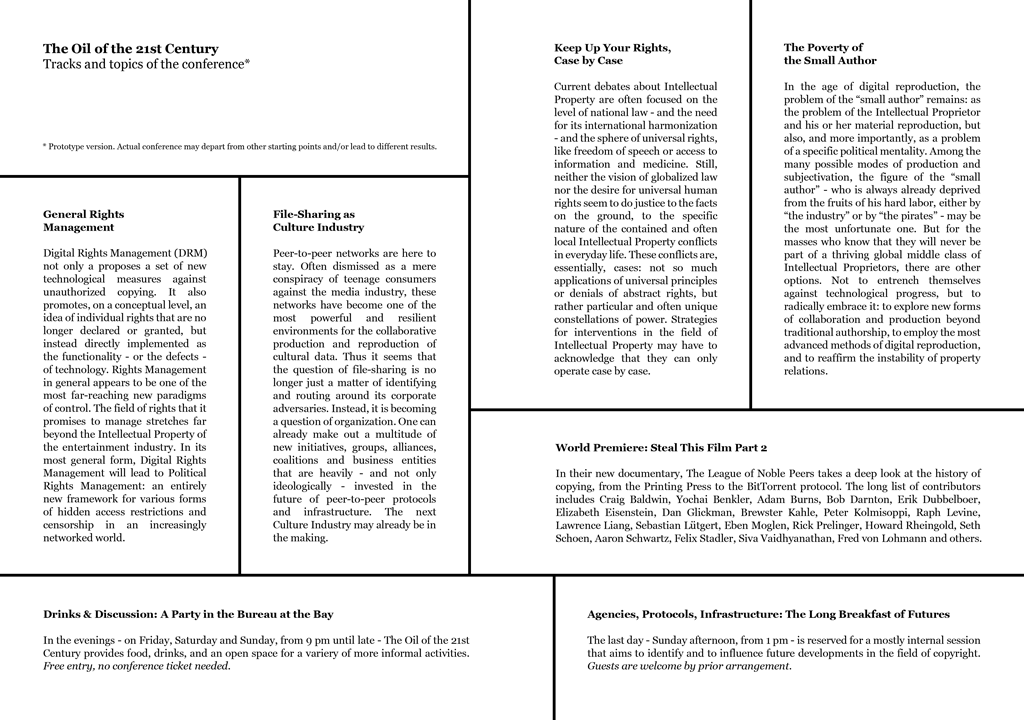
    Steal This Film (Part 2)[9] (sometimes subtitled 'The Dissolving Fortress') was produced during 2007. It premiered (in a preliminary version) at a conference entitled "The Oil of the 21st Century - Perspectives on Intellectual Property" in Berlin, Germany, November 2007.[10]

    Thematically, Part 2 "examines the technological and enforcement end of the copyright wars, and on the way that using the internet makes you a copier, and how copying puts you in legal jeopardy."[11] It discusses Mark Getty's assertion that 'intellectual property is the oil of the 21st century'. Part 2 draws parallels between the impact of the printing press and the internet in terms of making information accessible beyond a privileged group or "controllers". The argument is made that the decentralised nature of the internet makes the enforcement of conventional copyright impossible. Adding to this the internet turns consumers into producers, by way of user generated content, leading to the sharing, mashup and creation of content not motivated by financial gains. This has fundamental implications for market-based media companies. The documentary asks "How will society change" and states "This is the Future - And it has nothing to do with your bank balance".

    Boing Boing's Cory Doctorow called it 'an amazing, funny, enraging and inspiring documentary series', and Part II "even better than part I."[11]


    Trial Edition

    A Trial Edition (also known as '2.5' or 'Spectrial' edition) was released to coincide with the trial in 2009 of The Pirate Bay. This version includes material from Steal This Film I and II combined with new interviews shot with Peter Sunde and others during 2008, some historical background about the Pirate Bay and Dutch printers (who were also considered pirates) as well as interview clips about the legal conflict itself.[12] Steal This Film 'Spectrial Edition' is widely available online and it is thought to be this version that is now available to television stations and others. One high-definition, full-length copy is available for online viewing on the popular video-sharing website YouTube.[13].

    The new edition of Steal This Film was part of the Official Selection and in competition at the 2009 Roma Fiction Festival (Factual strand).[14][15] The jury awarded a Special Mention for its "unconventional style and provocative look at the media revolution taking place in the world."[16]


    Festivals, Cinema and Other Screenings

    Steal This Film was selected for the Sheffield International Documentary Film Festival 2008,[17] South By Southwest festival 2008 in Austin, Texas,[18] and the Singapore International Film Festival 2008.[19] Other festivals at which it was shown included Tampere Film Festival, 2008[20], Salt Spring Film Festival 2007[21], Rhythm of the Line Festival 2007[22] and Kerala International Film Festival, India.[citation needed] Steal This Film was nominated for the Ars Electronica 2008 Digital Communities prize[23] and was a semi-finalist in online video-streaming site Babelgum's 2008 competition. Amongst others it has been shown on History Channel Spain, Canal + Poland, Noga Israel, TV4 Sweden and Dublin Community TV, Ireland.[citation needed]

    The film is taught in Universities on media courses worldwide, including NYU's Media Culture & Communication course.[24]


    Online Distribution

    The film is famous partly for being one of the most downloaded documentaries to date. Part One was released through an arrangement with The Pirate Bay; the filesharing site marketed Steal This Film in place of its own pirate ship logo. This produced millions of downloads for the film and catapulted it to wide recognition on the Internet after it hit Digg, Slashdot, Reddit and other online centers of attention.

    Steal This Film (Part 2) was distributed in a similar manner, but with more trackers and indexes involved, including Isohunt and Mininova. Estimates of the total current downloads of the film hover at around the 6 million mark via bittorrent alone. Since the creators have not attempted to restrict copying, the film is also available on YouTube, Google Video and many other web-based video service.

    A cam version leaked soon after the premiere of Steal This Film (Part 2) in Berlin.[25] Part 2 had its theatrical (rather than viewed online) premiere at the openly-organised Who Makes And Owns Your Work artistic seminar in Stockholm 2007.[26] Despite the principles of the seminar itself (organised via public wiki in a year-long process), the involvement of Piratbyran roused the funders of the seminar, the Swedish Arts Grants Committee, to prohibit Piratbyran's logo on the seminar marketing materials alongside its own.[27] The seminar initiators' solution was to add a black sticker dot over the logo, which was easily peeled off. Another condition given by the Committee was that a moderator or an anti-piracy spokesperson be present to balance the debate.[28]


    Film poster mockup used the logo for The Pirate Bay

    The documentary was officially released for peer-to-peer filesharing using peer-to-peer networks on December 28, 2007 and, according to the filmmakers, downloaded 150,000 times in the first three days of distribution.[29] Pirate Bay encouraged the downloading of Steal This Film Two, announcing its release on its blog.[30] Steal This Film Part 2 was also screened by the Pirate Cinema Copenhagen in January 2008.[31] The documentary can also be downloaded on the official Steal This Film website.[32]


    Language

    Like Part One, Part Two is in Swedish. Part One had subtitles in English. Due to great interest in the documentary by volunteer translators, Part Two has subtitles in Czech, Croatian, Danish, Dutch, French, Finnish, German, Greek, Hungarian, Italian, Polish, Portuguese, Russian, Spanish, Turkish and Ukrainian.


    Financing

    As well as funding from BritDoc, the Steal This Film producers continues to utilize a loose version of the Street Performer Protocol[citation needed], collecting voluntary donations via a PayPal account, from the website.[33] For future financing, director Jamie King has written that he and the League of Noble Peers propose, a "post IP compensation system" which "allows viewers and listeners to make voluntary payments right from the client in which they play media." [34]


    Donations

    The League of Noble Peers asked for donations and more than US$30,000 has been received as of July 5, 2009.[35] The filmmakers report that roughly one in a thousand viewers are donating, mostly in the range USD $15–40.


    Credits

    Steal This Film One and Two are credited as 'conceived, directed, and produced' by The League of Noble Peers. Where Part One contains no personal attribution, Part Two has full credits.

    The League of Noble Peers are now working on a cinema release of Steal This Film.[citation needed]


    See also


    References

    1. ^ Steal This Film: Things You Can Help With Wikidot.com, Steal this film Wiki. Anonymous, Last modified February 2006. Retrieved 2010-02-20
    2. ^ "Steal This Film - Projects". StealThisFilm.com. 2006,2007. http://www.stealthisfilm.com/Part2/projects.php. Retrieved 2010-04-10. 
    3. ^ "Steal This Film (Part 1)". StealThisFilm.com. http://www.stealthisfilm.com/Part1/. Retrieved 2010-02-20. 
    4. ^ "Documentary Film Video: Listing for Steal This Film". DocumentaryFilm.net. http://www.documentary-film.net/search/video-listings.php?e=57. Retrieved 2010-02-20. 
    5. ^ Doctorow, Cory (August 23, 2006). Steal This Movie: documentary on Swedish piracy movement. BoingBoing.net. Retrieved 2010-04-09.
    6. ^ Flint, James (September 25, 2006). "Steal This Film, read this article". The Guardian. http://film.guardian.co.uk/features/featurepages/0,,1880222,00.html#article_continue. Retrieved 2010-02-20. 
    7. ^ Search, Jess; King, Jamie; et. al. (July 27, 2007). "Britdoc 07 Talking Sessions: Steal This Film". BritDoc Foundation. http://foundation.britdoc.org/festival/07/talking.php. Retrieved 2010-04-10.  Audio parts 1 & 2.
    8. ^ Mayes, Tessa (August 6, 2007). "Don’t steal this article - but please do discuss it". Spiked Online. Retrieved 2010-04-09.
    9. ^ Steal This Film (Part 2). StealThisFilm.com. Retrieved 2010-04-10.
    10. ^ "Oil of the 21st Century Conference". Oil21.org. http://oil21.org/png/conference0607large.png. Retrieved 2010-02-20. 
    11. ^ a b Doctorow, Cory (December 29, 2007). "Steal This Film, Part II: the Internet makes us into copiers". Boingboing.com. http://www.boingboing.net/2007/12/29/steal-this-film-part.html. Retrieved 2010-02-20.  Early review.
    12. ^ Roettgers, Janko (February 18, 2009). "New Steal This Film Documentary Just In Time For Pirate Bay Trial". GigaOM. Salon.com. http://www.salon.com/technology/the_gigaom_network/online_video/index.html?section=online_video&blog=/tech/giga_om/online_video/2009/02/17/new_steal_this_film_documentary_just_in_time_for_pirate_bay_trial. Retrieved 2010-04-10. 
    13. ^ Steal This Film - Trial Edition (video). YouTube.com. Uploaded February 17, 2009. Retrieved 2010-02-20.
    14. ^ Roma Fiction Festival 2009 selection of Steal This Film II.[dead link]
    15. ^ DRTV (8 July 2009). RomaFictionFest: il programma di oggi, mercoledì 8 luglio 8 (in Italian). TVGuida.com (Italy). Retrieved 2010-07-16. English tr.
    16. ^ RED/DBR (11 July 2009). SPE - RomaFictionFest: edizione da record, sfiorate 43mila presenze (in Italian). ilVelino.it; il Velino (Italy). Retrieved 2010-07-16. English tr.
    17. ^ Sheffield International Documentary Film Festival 2007 Film Schedule (PDF). SheffDocFest.com. November 8, 2008. Retrieved 2010-04-10.
    18. ^ South By Southwest 2008 Schedule and Screening Schedule SxSW.com, 2008. Retrieved 2010-04-10.
    19. ^ 21st Singapore International Film Festival - Screening Schedule 2008.
    20. ^ Tampere Film Festival 2008 listing of Steal This Film
    21. ^ Salt Spring Film Festival 2007 listing of Steal This Film[dead link]
    22. ^ Rhythm of the Line Festival (Germany) listing of Steal This Film.
    23. ^ Prix Ars Electronica 2008 nomination of Steal This Film.[dead link]
    24. ^ New York University, Media Culture & Communication 2008 Course including Steal This Film.
    25. ^ Steal This Film II - STF-II_CAM.avi(torrent) The Pirate Bay. Retrieved 2010-04-10.
    26. ^ Who Makes And Owns Your Work? Conference, 12 November 2007. Retrieved 2010-02-20.
    27. ^ Piratbyran Activities, 2007 (PDF). Piratbyran.org. 2008. Retrieved 2010-04-10.
    28. ^ Nygren, Tomas (November 13th, 2007) Gesamtkunstwerk: Who Makes and Owns Your Work launching at Årsta, Sat 17th November TomasNygren.org (photo, portions in Swedish). Retrieved 2010-04-10.
    29. ^ King, Jamie (January 3, 2008). "The Future Doesn't Care About The Bank Balance but the 1/1000 do!". Jamie.com. Archived from the original on 2008-02-12. http://web.archive.org/web/20080212085337/jamie.com/2008/01/03/the-future-doesnt-care-about-your-bank-balance-but-the-11000-do/. Retrieved 2010-02-20. 
    30. ^ The Pirate Bay - Blog Retrieved 2010-04-09.
    31. ^ Pirate Cinema Copenhagen Screening, January 13, 2008. Retrieved 2010-04-09.
    32. ^ Steal This Film Part 2 Download Official download page. StealThisFilm.com.
    33. ^ Donations Page Stealthisfilm.com.
    34. ^ King, Jamie (November 22, 2007) Content producers should take advantage of P2P, not fear it New Media Age. Retrieved 2010-04-10.
    35. ^ Ernesto (January 5, 2008). "When Pirates Pay, They Pay Good". TorrentFreak. http://torrentfreak.com/when-pirates-pay-they-pay-good-080105/. Retrieved 2008-01-08. 


    External links


    Source: http://en.wikipedia.org/wiki/Steal_This_Film

    http://www.stealthisfilm.com/

    https://blogger.googleusercontent.com/img/b/R29vZ2xl/AVvXsEieof4cnSRRi8lYxXSd5KuEdFNgVI9zTHqEckHXwh6l_Du6b73K55qraewl-gOYqlzK4yeYhZufJD_L1bo2q1y0APUoGhqXD0398-iPlQhaX-_0PHCIRrTCO0LraHWTUBMyJMRi3A4R/s1600/0.jpg[COMICS] "Jolly Roger - a history about copyright in cyberspace"


    Recommended Articles

    A selection of some TorrentFreak's classics dug up from our archives.
     

    Anti-Copyright Resources


    If we have right to use three things separately, I see nothing in reason or in the law, which forbids our using them all together. A man has a right to use a saw, an axe, a plane, separately; may he not combine their uses on the same piece of wood? He has a right to use his knife to cut his meat, a fork to hold it; may a patentee take from him the right to combine their use on the same subject?

    If nature has made any one thing less susceptible than all others of exclusive property, it is the action of the thinking power called an idea, which an individual may exclusively possess as long as he keeps it to himself; but the moment it is divulged, it forces itself into the possession of every one, and the receiver cannot dispossess himself of it.

    Its peculiar character, too, is that no one possesses the less, because every other possesses the whole of it.

    He who receives an idea from me, receives instruction himself without lessening mine; as he who lights his taper at mine, receives light without darkening me.

    That ideas should freely spread from one to another over the globe, for the moral and mutual instruction of man, and improvement of his condition, seems to have been peculiarly and benevolently designed by nature, when she made them, like fire, expansible over all space, without lessening their density in any point, and like the air in which we breathe, move, and have our physical being, incapable of confinement or exclusive appropriation.

    Inventions then cannot, in nature, be a subject of property.

    – Thomas Jefferson


    I have sworn upon the altar of God eternal hostility
    against every form of tyranny over the mind of man.


    – Thomas Jefferson


    Further information about anti-copyright will be forthcoming. In the meantime, check out the following:

    Source: http://praxeology.net/anticopyright.htm

    Original article:

    Steal This Film I (2006) + Steal This Film II (2007) + Trial Edition (2009) - Documentary Films and Resources


    Copying Is Not Theft - Official Version 


    .

    Anti-Copyright Resources

    Anti-Copyright Resources


    If we have right to use three things separately, I see nothing in reason or in the law, which forbids our using them all together. A man has a right to use a saw, an axe, a plane, separately; may he not combine their uses on the same piece of wood? He has a right to use his knife to cut his meat, a fork to hold it; may a patentee take from him the right to combine their use on the same subject?

    If nature has made any one thing less susceptible than all others of exclusive property, it is the action of the thinking power called an idea, which an individual may exclusively possess as long as he keeps it to himself; but the moment it is divulged, it forces itself into the possession of every one, and the receiver cannot dispossess himself of it.

    Its peculiar character, too, is that no one possesses the less, because every other possesses the whole of it.

    He who receives an idea from me, receives instruction himself without lessening mine; as he who lights his taper at mine, receives light without darkening me.

    That ideas should freely spread from one to another over the globe, for the moral and mutual instruction of man, and improvement of his condition, seems to have been peculiarly and benevolently designed by nature, when she made them, like fire, expansible over all space, without lessening their density in any point, and like the air in which we breathe, move, and have our physical being, incapable of confinement or exclusive appropriation.

    Inventions then cannot, in nature, be a subject of property.

    – Thomas Jefferson


    I have sworn upon the altar of God eternal hostility
    against every form of tyranny over the mind of man.


    – Thomas Jefferson


    Further information about anti-copyright will be forthcoming. In the meantime, check out the following:

    Source: http://praxeology.net/anticopyright.htm